Most agents who start shopping for the best camera for real estate video end up overspending on gear they never fully use. Real estate video doesn’t need 8K, 120fps slow motion or sports-grade autofocus tracking — it needs a wide field of view, clean low-light footage, in-body stabilization and 4K output. That narrows the field considerably, and it means you can ship buyer-ready video for under $2,000 in 2026.
This guide compares the five cameras that actually make sense for listing video this year — the Sony A7C II, Sony A7 IV, Canon EOS R8, Insta360 X4 and DJI Pocket 3 — plus the best lens for real estate video, the best drone, and an honest look at the AI alternative that’s now winning over agents who don’t want to invest in a camera at all. No marketing fluff, no affiliate-bait gear lists, just the picks that match how listing video actually gets shot in 2026.
What you actually need from a real estate video camera
The real estate video brief is narrow, and that’s a good thing for your wallet. You’re shooting interiors at 24mm equivalent, you’re moving slowly through rooms, you’re never tracking a moving subject. Most of the marquee specs that drive camera prices up — 30+ frames-per-second burst, animal eye autofocus, 8K oversampling — are completely irrelevant.
Here’s the actual checklist:
- Full-frame or large APS-C sensor. Interiors are dim, even when the sun is out. Bigger sensors gather more light, which means you can keep ISO low and footage clean. Phones and tiny-sensor action cams struggle once you step away from a window.
- Wide-angle lens, ideally 16-24mm full-frame equivalent. Real estate is about showing the whole space. A 16-35mm zoom on full-frame or a 10-18mm zoom on APS-C is the sweet spot.
- In-body image stabilization (IBIS). A gimbal is still your best friend, but IBIS means handheld B-roll and detail shots are usable straight out of the camera.
- 4K at 30fps minimum. 4K future-proofs the footage and gives you crop room when you reframe a shot in post. You don’t need 60fps unless you’re shooting slow-motion B-roll.
- Decent autofocus. Modern hybrid AF on any camera released after 2022 is more than enough. Don’t pay extra for sports-tier tracking.
- A flip-out screen. Useful for low-angle shots showing off floors, fireplaces or kitchen islands.
What you don’t need: 8K, internal RAW video, ultra-fast burst, ProRes recording, dual card slots. Real estate is a gentle, slow-paced shooting brief. Spend the savings on a gimbal and a wide lens.
The five short-listed bodies, side by side — full-frame mirrorless, hybrid 360, and gimbal pocket cameras all on the same desk:
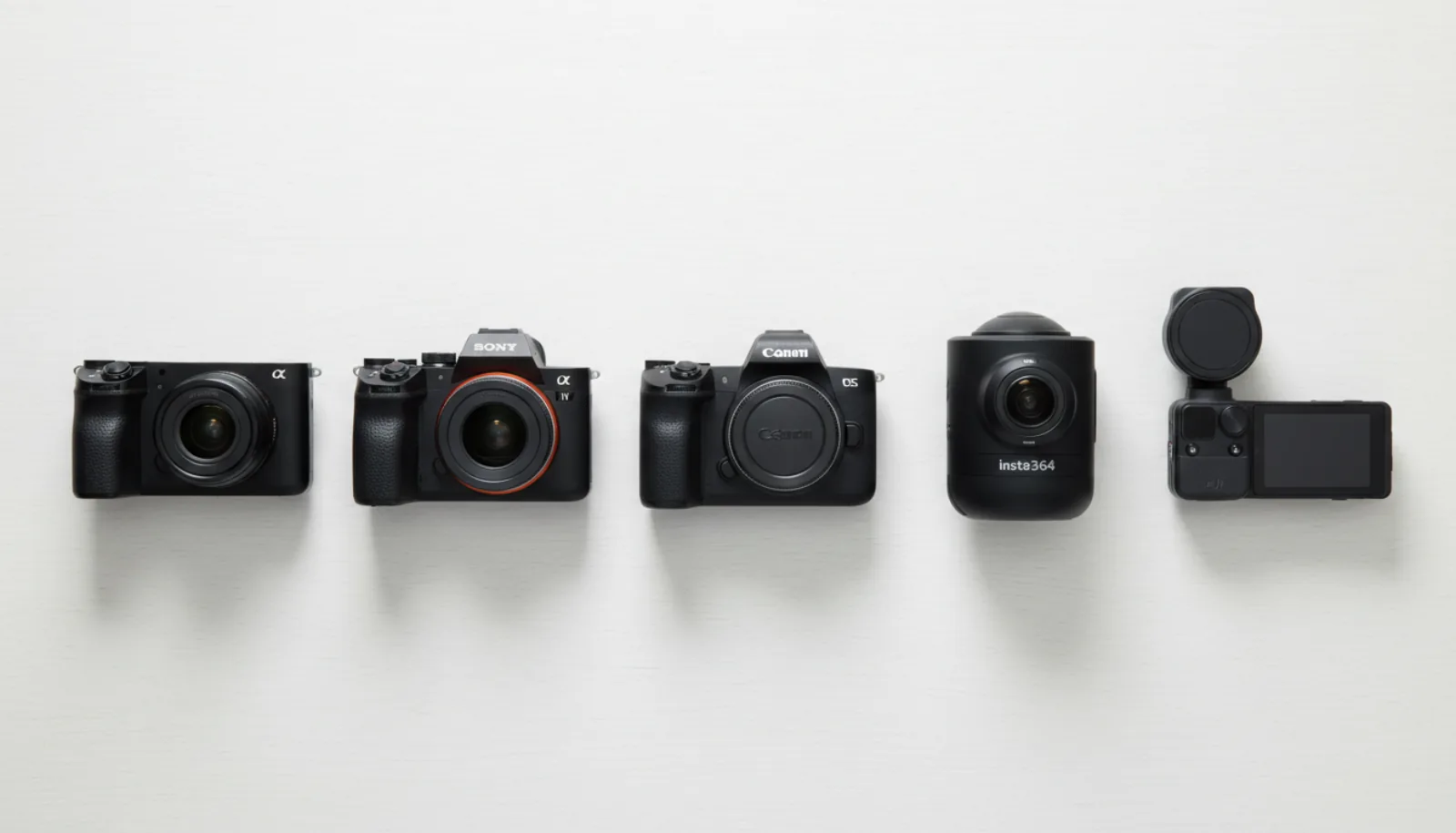
5 best cameras for real estate video — head-to-head
| Camera | Sensor | Stabilization | 4K | Street price | Best for |
|---|---|---|---|---|---|
| Sony A7C II | Full-frame 33MP | 7-stop IBIS | 4K/60p | ~$2,000 | Most agents — best balance overall |
| Sony A7 IV | Full-frame 33MP | 5.5-stop IBIS | 4K/60p | ~$2,500 | Established agents who want more grip and dual card slots |
| Canon EOS R8 | Full-frame 24MP | Digital IS only | 4K/60p | ~$1,500 | Budget full-frame shooters who already use a gimbal |
| Insta360 X4 / X5 | Dual 1/2” 360° | FlowState | 8K 360° + flat reframe | ~$500 | Solo agents who want 360° + flat output from one capture |
| DJI Pocket 3 | 1” sensor | 3-axis gimbal built in | 4K/120p | ~$520 | Agents who want one-handed, walk-and-shoot simplicity |
Sony A7C II — recommended #1
The A7C II is the camera I’d hand to any agent serious about doing video in-house. It’s a compact full-frame body with 7-stop in-body stabilization, 4K up to 60p, and the same 33MP sensor used in the A7 IV. Autofocus is excellent, and the small body pairs well with a gimbal because it doesn’t fight the gimbal’s motors with excess weight.
Pros: Compact for full-frame, 7-stop IBIS handles handheld B-roll without a gimbal, excellent dynamic range for high-contrast interiors with bright windows, dual-format SD/CFexpress optional.
Cons: Single card slot, the small body can feel cramped if you have larger hands, no joystick-style AF point selector.
Ideal user: Solo agents and small teams shooting one or two listing videos a week who want a single body that handles photos, video and B-roll without compromise.
Sony A7 IV — for established agents
The A7 IV is the A7C II’s bigger sibling. Same sensor, slightly older IBIS rating but more robust ergonomics, dual card slots and a beefier grip. If you’re already shooting stills professionally and want one body that does everything, this is the obvious choice. For pure listing video, the A7C II is better value, but the A7 IV ages better as a hybrid workhorse.
Pros: Pro-grade ergonomics, dual card slots, slightly better video heat management, full-size HDMI port.
Cons: Heavier on a gimbal, costs $500 more than the A7C II for marginal listing-video benefit.
Ideal user: Agents who also shoot stills professionally and want one body for everything.
Canon EOS R8 — budget full-frame
The R8 is the cheapest full-frame mirrorless camera with usable real estate video specs. It’s missing IBIS — which matters more for handheld stills than gimbal-mounted video — but the autofocus is class-leading and the 4K/60p output looks fantastic. Pair it with a Canon RF 16mm f/2.8 and you’ve got a sub-$2,000 kit that punches well above its price.
Pros: Full-frame at a $1,500 price point, best-in-class Dual Pixel AF II, excellent skin tones if you shoot agent-intro selfies.
Cons: No IBIS (mandatory gimbal for handheld), shorter battery life than Sony bodies, only one card slot.
Ideal user: Cost-conscious agents who already own a gimbal and want maximum sensor for minimum spend.
Insta360 X4 (or X5) — 360° + flat output combo
The X4 captures the entire scene, then lets you reframe in post — pull a smooth 4K horizontal walkthrough out of an 8K 360° capture, and a 9:16 vertical reel from the same file. This is uniquely useful for real estate because you can shoot a property once, walk through every room with one device, and pull six different videos out of the same footage. It also doubles as the 360° camera you’d use for a real estate virtual tour software workflow.
Pros: One capture pass covers every angle, FlowState stabilization is genuinely impressive, doubles as a virtual-tour camera.
Cons: Smaller sensors than dedicated cameras (low-light footage is noisier), reframing workflow has a learning curve, output sharpness is below a full-frame mirrorless.
Ideal user: Solo agents who want maximum coverage with minimum on-site time.
DJI Pocket 3 — easiest mode for daily shooting
The Pocket 3 is a 1-inch-sensor camera with a 3-axis gimbal built into the body. It’s tiny, charges in 16 minutes, and produces stabilized 4K footage that doesn’t need any external rig. For agents who want to walk into a listing, capture a 90-second tour and post it the same day, nothing comes close. It’s not as cinematic as a full-frame camera, but the speed-to-publish ratio is unmatched.
Pros: Pocketable, built-in gimbal, fast-charging, vertical-shoot mode for Reels and TikTok built in.
Cons: 1-inch sensor struggles in low light, no interchangeable lens, fixed 20mm equivalent focal length is slightly tight for small rooms.
Ideal user: Agents who post daily social video and want one tool that fits in a glove box.
For the head-to-head between the two full-frame bodies most agents end up choosing between — Canon’s R6-class hybrid vs. the Sony A7 IV — Ted Forbes’s side-by-side test on PetaPixel’s channel is one of the more useful comparisons:
If the question is more “do I even need a full-frame camera, or can a DJI Pocket / Insta360 cover this?” — Tech Court’s recent comparison of the two pocket-class options frames the trade-off plainly:
Best lens for real estate video
If you go the full-frame route, the best lens for real estate video is the Sony 16-35mm f/2.8 GM II (or its predecessor) for Sony bodies, and the Canon RF 15-35mm f/2.8 L for Canon. Both are pricey, but the wide-end 16mm focal length is what makes small bedrooms and bathrooms look spacious without distorting the shot into fish-eye territory.
If that’s out of budget, two cheaper picks earn their spot:
- Sony 16-35mm f/4 PZ G (~$1,200) — power-zoom, lightweight, smooth zoom for video. Trades a stop of light for half the weight and price.
- Canon RF 16mm f/2.8 STM (~$300) — single focal length, plastic build, but optically excellent for the price. The default starter lens for the EOS R8.
For APS-C bodies, the Sony 10-20mm f/4 PZ G or Canon RF-S 10-18mm give you the same wide-angle real-estate look at a fraction of the cost.
The mistake I see most often: agents pairing a full-frame body with a 24-70mm zoom and wondering why their interiors look cramped. Spend the lens budget on something that goes to 16mm. The body matters less than the wide end of your zoom.
Best drone for real estate video
The best drone for real estate video for most agents in 2026 is the DJI Mini 4 Pro (~$760 with the standard controller). It weighs sub-249g, which in many jurisdictions exempts hobbyist use from FAA Part 107 commercial drone licensing — but if you’re flying for paid listings in the US, you still need Part 107 regardless of weight. Always check your local regulations before flying for a client.
The Mini 4 Pro shoots 4K/100fps, has obstacle sensing on all sides, and the DJI RC 2 controller has a built-in screen so you don’t tether your phone. It folds down to roughly the size of a paperback book.
If you want to step up, the DJI Air 3S (~$1,100) has dual cameras (wide + medium telephoto) which is genuinely useful for parallax exterior shots, longer flight time, and a slightly larger sensor. For most agents the Mini 4 Pro is plenty — the upgrade is mainly for photographers who want stills as well as video.
Skip racing drones, FPV drones and anything heavier than the Air 3S. Real estate aerial shots are slow, smooth orbits and reveal pulls — the Mini 4 Pro nails this brief.
The AI alternative — skip the camera entirely
Here’s the honest take that camera-review blogs won’t give you: most agents shoot a listing video twice a year, get frustrated by the workflow, and stop. The gear sits in a closet. If that’s you, a $2,000 camera kit is the wrong investment.
The alternative is generating the video from the listing photos you’d already shoot for the MLS. BrightShot’s AI video tour builder takes your stills, adds realistic camera moves (pans, tilts, dolly-ins), picks a music mood that matches the property, optionally adds a voiceover narration, and exports both 1080p horizontal and 9:16 vertical versions in under a minute. There’s no shoot day, no gimbal, no editing timeline.
Try BrightShot’s AI video tour builder free — Generate a buyer-ready cinematic walkthrough from your existing listing photos in under a minute. Cinematic, upbeat, chill or ambient music moods, 1080p horizontal + 9:16 vertical exports, optional AI voiceover. Generate Your First AI Video Free →
Will it replace a great videographer for a $5M luxury listing? No. Should you still own a camera for hero shots and brokerage-level marketing? Probably yes. But for the 80% of listings where you can’t justify a one-hour shoot day — the $300K starter homes, the rentals, the pocket listings, the back-on-market relisting — an AI real estate video maker gets you a publishable video in the time it takes to import the photos.
The most realistic 2026 setup for an agent doing 30+ listings a year: a Sony A7C II for hero properties, an iPhone with a gimbal for B-roll and agent-intro clips, and BrightShot for everything else. That covers every price point in your inventory without owning a closet full of gear.
For agents who want to take whatever they shoot — phone, mirrorless or AI-generated — and refine it further, our guide to real estate video editor workflows walks through the post-production pass that ties a multi-source video together.
FAQ
What is the best camera for real estate video?
For most agents in 2026, the Sony A7C II is the best camera for real estate video. It pairs a full-frame 33MP sensor with 7-stop in-body stabilization and 4K/60p output in a body small enough to live on a gimbal all day. At $2,000 it sits in the sweet spot between budget options like the Canon EOS R8 ($1,500) and pro hybrids like the Sony A7 IV (~$2,500). If you want one camera that handles listing video, agent-intro clips and stills photography without compromise, the A7C II is the answer.
Do I need a 4K camera for real estate?
Yes — but not for the reason most blogs claim. You don’t need 4K because buyers are watching on 4K screens (most aren’t). You need 4K because shooting in 4K and exporting to 1080p gives you crop room in post: you can reframe a shot, stabilize footage further, or pull a vertical 9:16 social clip out of a horizontal capture without losing resolution. Every camera on this list shoots 4K at 30fps or higher, which is the new minimum for 2026.
What’s the best budget camera for real estate video?
Under $1,500, the Canon EOS R8 is the best budget camera for real estate video — full-frame, 4K/60p, class-leading autofocus. Under $600, the DJI Pocket 3 is hard to beat for ease of use, and the Insta360 X4 doubles as a 360° camera for virtual tours. If you already own an iPhone 15 Pro or newer, paired with a $130 DJI Osmo Mobile gimbal you can shoot listing video that rivals an entry-level mirrorless setup — the gear gap has narrowed dramatically since 2023.
Can I shoot real estate video on an iPhone?
Yes. The iPhone 15 Pro and newer shoot 4K ProRes, have excellent computational stabilization, and pair beautifully with a $130 phone gimbal like the DJI Osmo Mobile 6 or Insta360 Flow 2. The honest tradeoffs versus a mirrorless camera: phone footage looks slightly flatter in dynamic range (bright windows clip more easily), low-light footage is noisier, and you can’t swap to a wider lens. For 80% of listings, none of those tradeoffs matter. For luxury and hero properties, a full-frame mirrorless still has the edge.