How much does Matterport cost? The published software pricing is genuinely transparent — there’s a free tier, and paid plans start in the low double digits per month. The real cost is the hardware you need to actually capture spaces and the per-active-space hosting model that scales with your portfolio. Most “Matterport cost” content online answers only one half of the question, which is why agents end up surprised when their first quarterly bill includes a $5,000+ camera, hosting fees, and add-on per-tour charges they didn’t see coming.
This post does the full math: camera options at every price point, the published software tiers, three worked examples for solo / mid-volume / brokerage agents, and a comparison against the cheaper Matterport alternatives that have closed most of the feature gap in 2025-2026. Pricing on Matterport’s site has shifted multiple times in the last two years, so we’ve framed everything as “starts from” ranges rather than precise dollar amounts — always verify the current numbers on matterport.com/pricing and matterport.com/cameras before budgeting, especially for the camera, where the gap between Pro 2 (used) and Pro 3 (new) can be $4,000+.
TL;DR — Matterport all-in cost ranges (2026)
| Use case | Hardware (one-time) | Software (monthly) | 12-month all-in |
|---|---|---|---|
| iPhone capture only (free tier) | $0 | $0 | $0 |
| Solo agent, 5 tours/mo | $5,000-$6,000 (Pro 3) or $1,500-$3,000 (used Pro 2) | Starts ~$10/mo (Starter tier) | ~$5,100-$6,200 (new) / ~$1,600-$3,200 (used) |
| Mid-volume agent, 15 tours/mo | $5,000-$6,000 (Pro 3) | Starts ~$70-$100/mo (Professional tier) | ~$5,800-$7,200 |
| Brokerage, 50 tours/mo | $5,000-$6,000 (Pro 3) + iPhone fallback | Starts ~$300-$400/mo (Business tier) | ~$8,600-$10,800 |
Ranges reflect Matterport’s published tiers as of mid-2026. Hardware figures are retail; used Pro 2 cameras range $1,500-$3,000 on the secondary market. Verify both on matterport.com before committing.
Matterport camera cost
Matterport supports four capture paths, in roughly ascending cost and ascending fidelity:
Matterport Capture on iPhone (free). Any iPhone with a LiDAR sensor (Pro / Pro Max models from 2020 onward) can capture a space directly with the Capture app. Quality is markedly lower than the Pro cameras — both in resolution and in the cleanliness of the dimensional mesh — but it’s genuinely free, and it’s the right starting point for an agent who wants to try Matterport on a single listing before committing to hardware. The iPhone capture path is Matterport’s own answer to “how much does Matterport cost to start” — zero, if you already own a recent iPhone Pro.
Matterport Pro 3 (starts from ~$5,995 retail, plus accessories). The current flagship. The Pro 3 uses a true LiDAR scanner with extended outdoor range, 134-megapixel image capture, and significantly faster scan times than the older Pro 2. For a real-estate professional who plans to capture 20+ tours per month for at least two years, the Pro 3 is the unit Matterport is selling new today. Add a sturdy tripod ($150-$400) and a carrying case ($100-$200), and the realistic all-in is closer to $6,300-$6,600. Verify current Pro 3 pricing on matterport.com/cameras — it has shifted at least twice since launch.
Matterport Pro 2 (retired new, $1,500-$3,000 used). Matterport stopped selling the Pro 2 new in 2023, but the secondary market is healthy — agents quitting the platform list them on eBay, KEH, and used-camera marketplaces. A clean Pro 2 with low scan-count is a perfectly viable Matterport entry point if you don’t need the Pro 3’s outdoor LiDAR range. The unit is older and slower, but it produces output that is indistinguishable to most buyers from a Pro 3 scan.
Third-party 360 cameras (Insta360, Ricoh THETA Z1, $400-$1,200). Matterport’s “BYOC” path supports several third-party 360 cameras that Matterport’s processing pipeline can stitch into a digital twin. Quality is between iPhone and Pro 2 — better than the iPhone, not as clean as a Pro scan. For agents who already own one of these cameras for other tour platforms (Kuula, CloudPano, Zillow 3D Home), this is a cost-effective on-ramp.
The honest agent math: if you’re listing fewer than 5 properties a year, capture with the iPhone or skip Matterport entirely. If you’re at 10-30 listings a year, a used Pro 2 is the breakeven point. If you’re a high-volume agent or photographer, the Pro 3 amortizes inside the first 18 months.
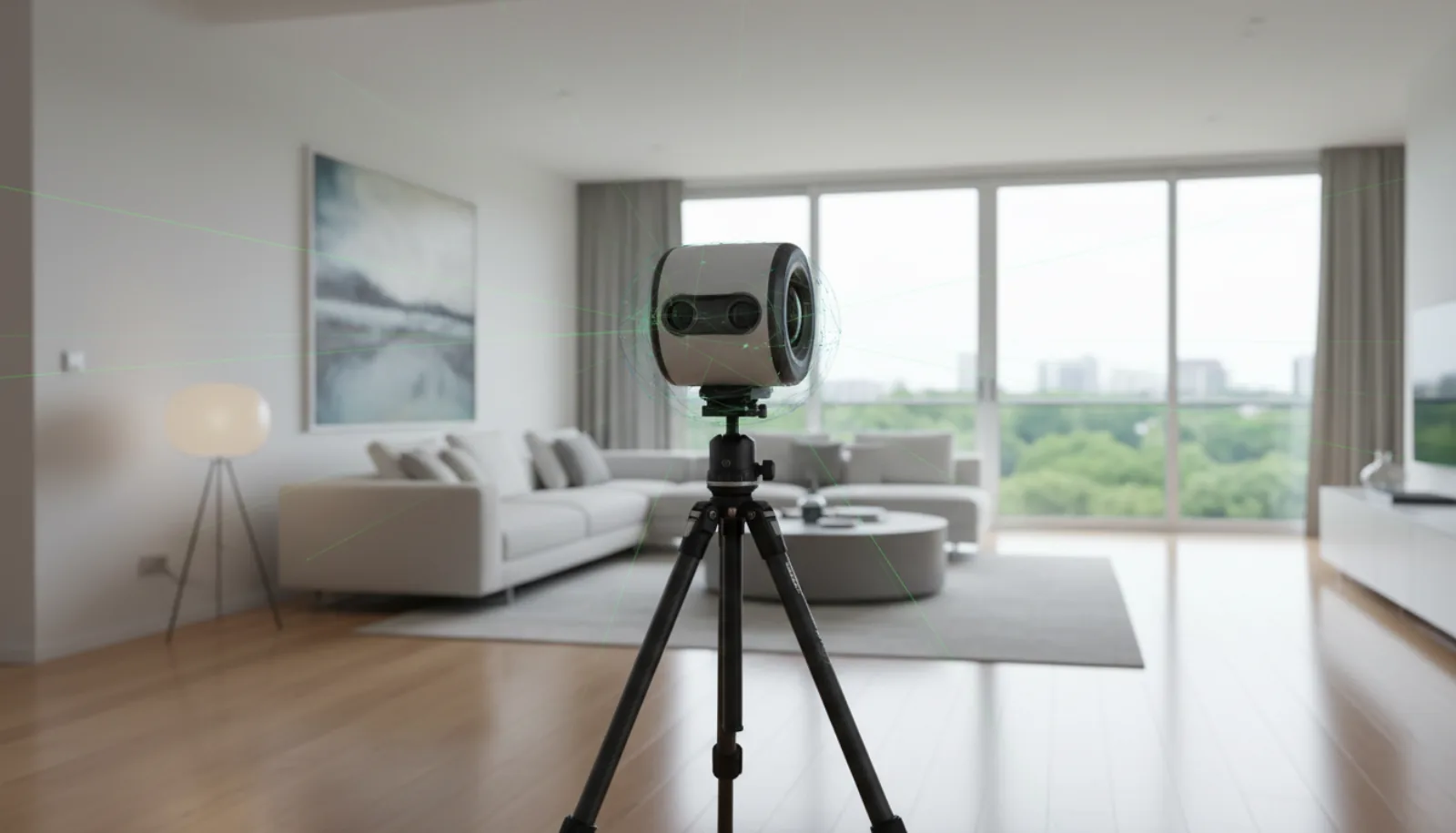
What the Pro 3 actually looks like deployed in a typical residential scan — tripod-mounted, mid-room, rotating through a 360° pass:
For a real-world look at a Pro 3 house scan from setup to finished 3D tour, the Sparks Media Group walkthrough is one of the cleaner end-to-end demos:
Matterport software / hosting cost
Matterport’s software pricing is built around the concept of an active space — each active space is one published 3D model. Plans differ in (a) how many active spaces you can host simultaneously and (b) which advanced features you unlock (MatterPak floor-plan exports, BIM files, video, custom branding, team seats). Pricing is published on matterport.com/pricing and has been adjusted at least twice since 2023; the framing below reflects the structure as of mid-2026.
Free tier. One active space, basic features, watermarked. Useful as a “try before you commit” path or for a single flagship listing — not viable as an ongoing agent workflow.
Starter tier (starts from ~$10/mo). A handful of active spaces, removed Matterport branding on tours, and the basic editor. Usable for an agent doing 1-3 listings per quarter who archives older tours after closing.
Professional tier (starts from ~$70-$100/mo). Tens of active spaces, schematic floor plans, basic team features, MatterPak floor-plan exports for an additional per-bundle fee. This is the realistic minimum for a working solo agent who keeps tours live for the full marketing cycle of every listing.
Business tier (starts from ~$300-$400/mo). Hundreds of active spaces, multi-seat team management, advanced branding controls, API access, and the integrations a brokerage needs to connect Matterport to its CRM, MLS feed, and IDX. This is where most multi-agent operations land.
Enterprise. Custom pricing for AEC firms, large multifamily, and commercial real estate operations that need unlimited active spaces, security review, and integration support.
The trap most agents fall into is the active-space hosting math. Tours don’t disappear when a property closes — they sit on your account, counting against your active-space allowance, until you archive them. An agent who closes 30 listings a year on the Professional tier without archiving will hit the active-space cap inside 18 months and be forced to upgrade or archive aggressively. The good news: archiving is free and reversible (you can restore any archived tour later); the bad news: most agents don’t know this until their first cap-warning email.
Add-ons that aren’t in the base tier: MatterPak floor-plan bundles ($X per delivery), schematic floor plans (sometimes per-tour, sometimes included by tier), BIM file generation (per-space), video walkthroughs (per-render), and tour translation services. None of these are deal-breakers individually; collectively they can add 20-40% on top of the base monthly subscription. Always re-check the current add-on pricing on matterport.com — these line items move the most often.
Total cost of Matterport for a real estate agent — three worked examples
Hardware + software is straightforward; the all-in 12-month total is where most agents get surprised. Here are three realistic scenarios.
Example 1 — Solo agent, 5 tours/month
Hardware: Used Pro 2, $2,200 + tripod $150 = $2,350 one-time (or Pro 3 new at ~$5,995 + tripod $250 = $6,245 if you’re committed to the platform for 3+ years).
Software: Starter or low-end Professional tier — the agent at 5 tours/month with aggressive archiving can stay on Starter at $10/mo ($120/yr); at 5 tours/month without archiving, they’ll need Professional at $70-$100/mo ($840-$1,200/yr) by month 9.
12-month all-in (used Pro 2, archived): ~$2,470. 12-month all-in (Pro 3, no archiving): ~$7,200-$7,500.
Worth it? At ~$200/month all-in on the cheap path or ~$600/month on the premium path, the question is whether 5 tours/month produces enough listing-presentation wins to cover that overhead. For most $400K+ listings in competitive markets, yes — Matterport visibly differentiates a listing presentation. Below $300K, the math gets thinner.
Example 2 — Mid-volume agent, 15 tours/month
Hardware: Pro 3 new, $5,995 + tripod $250 + case $150 = $6,395 one-time. (At 15 tours/month, the speed advantage of the Pro 3 over a used Pro 2 actually matters — you’re spending 30-45 minutes per scan with a Pro 2 vs. 15-25 with a Pro 3.)
Software: Professional tier — needs to be Professional from day one because of active-space count. Realistic monthly is ~$100-$120/mo with 1-2 MatterPak floor-plan bundles per month at $30-$50 each. Annual: ~$1,800-$2,400.
12-month all-in: ~$8,200-$8,800. Per-tour math: roughly $45-$50/tour amortized. That’s competitive with paying a third-party Matterport service provider per listing ($150-$300 each), but only if you’re actually shooting all 15 yourself.
Example 3 — Brokerage, 50 tours/month
Hardware: 1-2 Pro 3 cameras for in-house production ($5,995-$11,990) + iPhone Capture as fallback for agents who prefer to shoot themselves. Most brokerages buy one Pro 3 for the in-house production team and let individual agents use iPhone Capture for lower-stakes listings.
Software: Business tier from day one. Realistic monthly is ~$400-$500/mo with team seats and the integration features the brokerage needs. Annual: ~$5,000-$6,000.
12-month all-in: ~$11,000-$18,000 depending on hardware decisions. Per-tour: ~$18-$30 amortized. This is where Matterport’s economics actually work — the per-tour cost drops dramatically with volume.
The honest takeaway: Matterport gets cheaper per tour as volume scales, which is the opposite of how most marketing tools work. A solo agent at 5 tours/month is paying $200-$600/tour effectively; a brokerage at 50 tours/month is paying $20-$30/tour. If you’re not in the mid-to-high volume bracket, alternative platforms produce better unit economics.
Matterport vs. cheaper alternatives
Matterport’s spatial accuracy and the Pro 3’s LiDAR-grade fidelity are real differentiators — for AEC, commercial, and high-end residential, those things matter. For a working real-estate agent at 5-15 tours/month, several alternatives produce a perfectly viable buyer-facing tour at a fraction of the all-in cost.
| Platform | Camera required | Starting price | All-in for 10 tours/mo | Best for |
|---|---|---|---|---|
| Matterport | Pro 3 ($5,995) or iPhone (free) | ~$10/mo (Starter) → $300+/mo (Business) | ~$6,200 (year 1) | High-end, AEC, brokerages with 30+ tours/mo |
| BrightShot | None — uses listing photos | Free trial; paid from ~$29/mo | ~$350-$500/year | Agents who already shoot photos and want a fast AI tour |
| Kuula | Any 360 camera ($400-$1,200) | Free / Pro from $16/mo | ~$600-$1,500 (year 1) | Photographers who already own a 360 camera |
| CloudPano | Any 360 camera | Free / Pro from $33/mo | ~$800-$1,700 (year 1) | Brokerages wanting white-label + live video chat |
| Panoee | Any 360 camera | Free / Pro from $9/mo | ~$500-$1,300 (year 1) | Solo agents on the tightest budget |
The honest framing: Matterport wins on dimensional accuracy and brand recognition (buyers searching Zillow recognize the Matterport “dollhouse” view). Everyone else wins on speed-to-publish and total cost of ownership. For most agents in 2026, the right move is to default to a non-Matterport workflow and add a Matterport tour for flagship listings only — the all-in math is better, and the buyers who specifically value Matterport are usually the same buyers who tolerate the wait for one.
If you’re evaluating both, our BrightShot vs. Matterport comparison walks through the feature-by-feature side-by-side. For a broader scan of the category, the best 360 virtual tour software breakdown covers 12 platforms across price points.
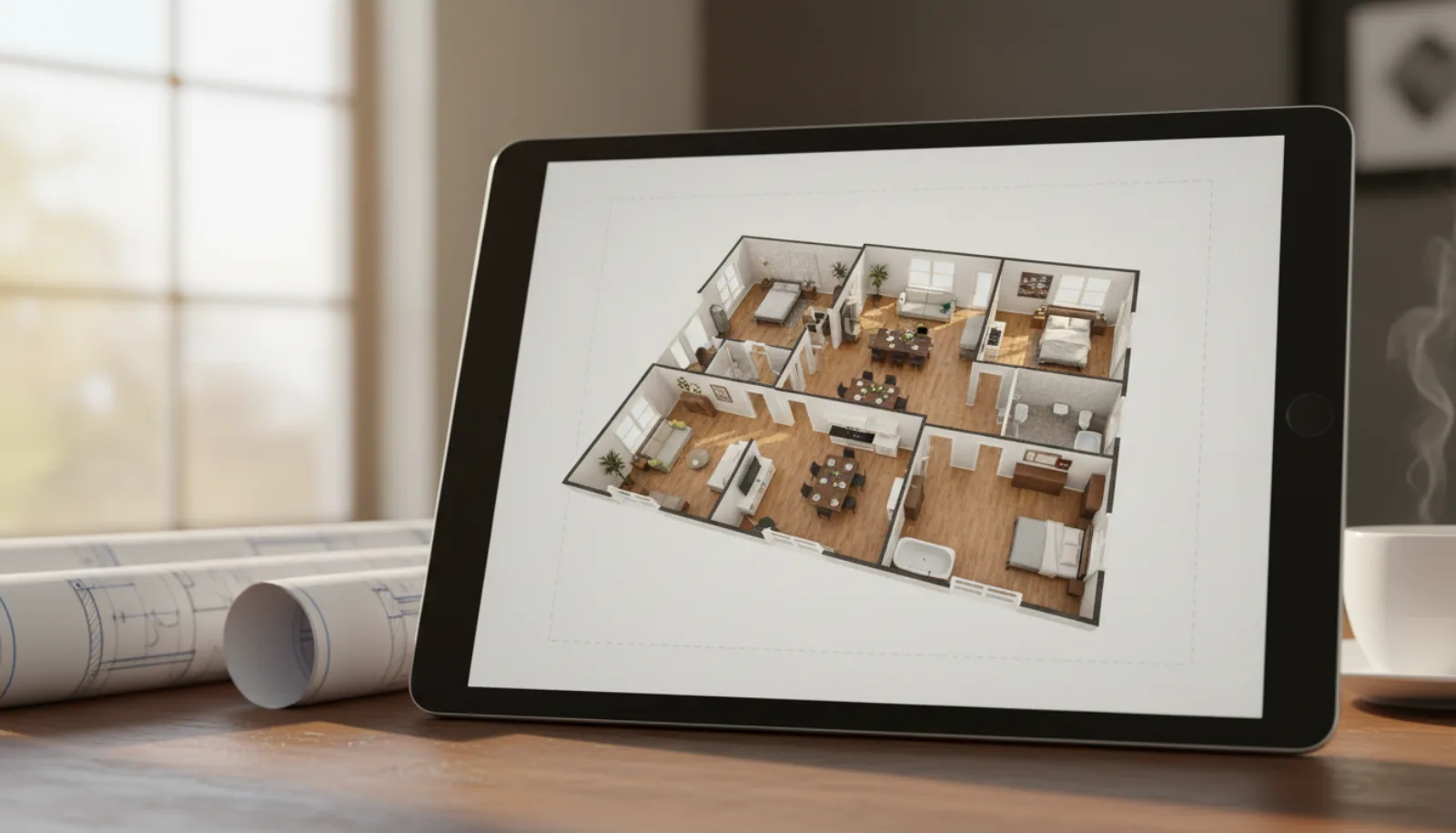
The output buyers actually click through is the dollhouse view — a cutaway aerial of the whole home, all rooms visible at once:
For Matterport’s own onboarding video — the official getting-started walkthrough that covers the marketing side of using a Pro 3 on a listing — the Matterport channel’s overview is the most direct source:
🏠 Build a virtual tour from your existing listing photos — no Matterport camera required. BrightShot turns standard real estate photos into a navigable 360° tour in under 60 seconds, with built-in virtual staging, decluttering, and lighting AI. No $5,995 camera, no per-active-space fees. Try the free real estate virtual tour software →
Is Matterport worth it?
Two-sided answer, because the honest one isn’t yes or no.
Matterport is worth it if: you’re shooting 20+ tours/month (the per-tour math drops below $50), your average listing price is $750K+ (buyers expect dimensional accuracy at that price point), you list commercial or AEC-adjacent properties (the LiDAR mesh is genuinely superior), or your brokerage’s brand requires the consistency of a single tour platform across 20+ agents.
Matterport is not worth it if: you’re a solo agent doing 1-5 listings per month (you’ll pay $100-$600 per amortized tour, which is more than buyers will reward you for), your average listing price is below $400K (the cost-per-tour eats too much of your commission), or you’re in a market where most listings don’t have 3D tours at all (you don’t need Matterport-level fidelity to differentiate — you just need any tour).
For the gray middle — solo agents at 8-15 tours/month, average listing price $400K-$750K — the math depends on whether you’d shoot the tours yourself (Pro 3 amortizes inside 12-18 months) or outsource to a Matterport service provider at $150-$300/tour (in which case you’re paying $1,500-$4,500/month for tours alone, and an alternative platform is almost certainly the better trade).
The single biggest mistake we see agents make on this question is buying the Pro 3 first and figuring out the volume after. Reverse that order: track your tour-per-month number for one quarter using iPhone Capture or a third-party platform, then make the camera decision once you know the actual volume.
FAQ
How much does Matterport cost?
Matterport cost has two parts: hardware and software. The free iPhone Capture path costs $0 if you already own a recent iPhone Pro with LiDAR. The Pro 3 camera starts from ~$5,995 retail; a used Pro 2 runs $1,500-$3,000 on the secondary market. Software starts from a free tier (1 active space, watermarked), with a Starter tier from ~$10/mo, Professional from ~$70-$100/mo, and Business from ~$300-$400/mo. A realistic 12-month all-in for a solo agent is $2,500-$7,500 depending on hardware choice; for a brokerage at 50 tours/month, $11,000-$18,000. Always verify current pricing on matterport.com/pricing.
Is there a free version of Matterport?
Yes. Matterport offers a free tier that allows one active 3D space and includes the basic editor — useful as a try-before-you-buy path or for a single flagship listing. Tours on the free tier are watermarked with Matterport branding, and active-space limits mean you can’t keep multiple tours live simultaneously. The Matterport Capture app for iPhone is also free to download and use, so you can capture a space at zero camera cost as long as you have an iPhone Pro with a LiDAR sensor.
What is the cheapest Matterport plan?
The cheapest option is the free tier, which supports one active space with watermarked output. The cheapest paid tier is Starter, which starts from approximately $10/month and lifts the watermark while supporting a small number of active spaces. For most working agents, Starter is too restrictive — the Professional tier (starts from ~$70-$100/month) is the realistic minimum for a regular workflow because it supports tens of active spaces and unlocks floor plans. Pricing has shifted multiple times since 2023, so verify the exact current numbers on matterport.com/pricing.
Do you need to buy a Matterport camera?
No. Matterport supports four capture paths: free iPhone Capture (any iPhone Pro with LiDAR, 2020 onward), supported third-party 360 cameras (Insta360, Ricoh THETA Z1) at $400-$1,200, the discontinued Pro 2 (used $1,500-$3,000), and the new Pro 3 from ~$5,995. For an agent doing fewer than 5 tours per month, iPhone Capture is genuinely viable — quality is lower than the Pro cameras, but the price-quality trade-off works for casual use. Above 10 tours/month, a Pro 2 (used) or Pro 3 (new) starts to amortize.
What is the best Matterport alternative?
The best alternative depends on what you actually need from Matterport. For agents who want a Matterport-style 3D tour without the $5,995 camera, BrightShot generates 360° tours from regular listing photos and bundles AI virtual staging, decluttering, and lighting in the same workflow — see the BrightShot vs. Matterport comparison. For photographers who already own a 360 camera, Kuula and CloudPano are the established Matterport alternatives at one-tenth the cost. For brokerages that need white-label tours with live video chat, CloudPano is the standard. For US agents whose primary distribution is Zillow, Zillow 3D Home is free and gets preferential placement on Zillow itself. We covered all 12 in the best 360 virtual tour software round-up.