Most content about real estate marketing for realtors is generic to the point of uselessness — “post on Instagram!”, “send postcards!”, “build your sphere!” — none of it tells you what to spend on, in what order, or with what cadence. Marketing for real estate agents in 2026 is not a vibe; it’s a stack with budgets, owners, and measurable outputs. This guide is operator-grade. By the end you’ll know which channels to fund this quarter, what each one costs, and the real estate marketing strategies that actually compound — instead of the trendy ones that burn out an agent in 90 days.
We’re writing this for working realtors: solo agents in their second year, team leads scaling to five producers, and brand-conscious brokerages trying to keep their listings looking consistent across thirty agents. The advice is the same playbook we’ve watched our top customers run. Some of it is uncomfortable — most “marketing as a realtor” today is over-invested in social and under-invested in the sphere of influence and the listing itself, where the actual revenue lives.
We won’t make up statistics. The real estate space is full of suspiciously precise “agents who do X earn 437% more” claims that get repeated until they feel like fact. Where we cite numbers, they’re either from the National Association of Realtors’ annual reports or framed as industry estimates. The exact numbers in your market will vary; the order of investment shouldn’t.
If you’re new to the business, work top to bottom — section 3 has a 30-day onboarding plan. If you’ve been selling for five years and want to find the next compounding channel, jump to sections 5 and 6.
The 5-channel real estate marketing stack
Every working agent’s marketing of real estate spend should map to five channels. Most struggling agents over-invest in two of them and ignore the other three. Here’s the operator framing — what each channel costs, what to expect, and when to fund it.
1. Listing portals (Zillow, Realtor.com, MLS, IDX)
Cost: $0 for MLS syndication; $300-$1,500/mo for Zillow Premier Agent in a competitive ZIP. Expect: the highest-intent buyer leads on the internet — people physically saving listings and requesting tours. When to invest: before everything else. The listing itself, presented well on portals, is the lead magnet. Pro photos, video, virtual tour, floor plan, and a real description are the prerequisite — not an upgrade.
2. Social media (Instagram, TikTok, Facebook, YouTube)
Cost: $0 for organic; $200-$2,000/mo if you boost. Expect: top-of-funnel awareness, sphere-of-influence reinforcement, and a small but real flow of inbound DMs. Social does not produce listings on its own; it produces consideration, which converts six months later when the seller’s brother-in-law mentions your name. When to invest: months 2-12 of your career, then maintain forever. Our social media marketing for real estate agents guide digs into platform strategy and content mix, and our 29 real estate social media post ideas gives you the templates to fill the calendar.
3. Email and SMS (the database channel)
Cost: $20-$100/mo for the platform; the database is free. Expect: the highest ROI channel by a wide margin. Email marketing for real estate consistently produces 30-40x return on dollars spent for agents who actually keep a database current — because referrals and repeat business are roughly a third of all transactions per NAR data. When to invest: day one. Build the list before you have anything to send.
4. Geo / community (postcards, signage, sphere)
Cost: $0.50-$1.20 per direct-mail postcard; $30-$200 per yard sign; $0 for sphere outreach. Expect: trust, recall, and farm-area dominance. Direct mail marketing for real estate is dismissed as old-school until you do the math: a 2,000-home farm at $0.80/postcard sent six times a year is $9,600 — less than two months of paid social, and it produces sellers who already know your name. When to invest: when you’ve identified a farm worth defending. Not before.
5. Paid advertising (Google + Meta)
Cost: $300-$3,000/mo, scaling with market. Expect: scaled buyer leads and seller-intent traffic — and a steep learning curve. When to invest: after the first four channels are humming. Paid ads multiply a working funnel; they don’t fix a broken one. Most new agents waste $5K-$10K on Facebook lead ads before realizing they didn’t have a follow-up system to convert the leads.
The order matters. Listings → email → social → geo → paid is the sequence we’ve seen the top 5% of agents follow. The bottom 50% start with paid social, get nothing, and quit.
The marketing stack itself is small — laptop, phone, a CRM tab, the listing flyer, and a calendar. The discipline is in running it every day, not in the tools:

The 30-day plan for new agents
If you just got your license, this is what your first month looks like. Marketing for new real estate agents is mostly about avoiding the trap of trying to do everything at once. Pick the one thing per week and ship it.
Week 1 — Brand setup. Get a professional headshot (not a phone selfie), claim your business name on Instagram, TikTok, Facebook, and YouTube, set up a Google Business Profile in your farm city, and build a single-page agent website with your bio, contact info, and a link to your MLS profile. Budget: $200-$500 for headshot + domain + basic Squarespace or Carrot site. Do not spend $5,000 on a custom website in week one. You don’t know what you need yet.
Week 2 — Sphere outreach. Make a list of every person who knows you and what you do — friends, family, former coworkers, your dentist. Aim for 100 names. Email each one a short, non-salesy “I just got my license, here’s how I help, please send anyone my way” note. Set a quarterly recurring calendar event to email the list with a market update. This list, kept warm, will produce your first three transactions.
Week 3 — First listing marketing. Whether the listing is yours or a teammate’s, build the full asset stack: pro photos, a 60-90s walkthrough video, a 360° virtual tour, a one-page MLS-ready listing description, and a just-listed Reel for Instagram and TikTok. Do this for every listing for the next year, no exceptions. The goal is to look — from day one — like the agent you’ll be in five years.
Week 4 — Lead-capture systems. Sign up for a CRM (Follow Up Boss is the default for a reason; LionDesk is cheaper if you’re bootstrapping), build a basic lead form on your website, set up automated email follow-ups for new inquiries, and connect every lead source to the CRM. By the end of week 4, every inbound — DM, sphere referral, open-house signup — should land in one place with a follow-up sequence already running. For the wider tooling stack — CRMs, marketing platforms, transaction tools — see our essential software for realtors breakdown.
What you’re explicitly not doing in month one: paid ads, a custom CRM, a podcast, a YouTube channel, or a $3,000 listing presentation template. Those are months 6-12. The 30-day plan is brand + sphere + first listing + capture system. Everything else is premature optimization.
For an hour-long version of the same first-30-days framework — what to actually do each day, with the scripts and weekly milestones — Kyle Handy’s training is the most thorough free version on YouTube:
The listing-by-listing marketing checklist
Every listing should get the same asset stack. Inconsistency is what makes some agents look amateur and others look like brands. Use this as a literal checklist — print it, tape it to your monitor, hand it to your assistant.
Visual assets:
- Professional photos (HDR, 25-40 images per listing)
- 60-90 second cinematic walkthrough video (16:9, MLS branded-video field)
- Two vertical Reels / TikToks (15-30s each, different hooks)
- 360° virtual tour (every room, hotspot navigation)
- Floor plan (2D minimum; 3D rendered for $500K+ listings)
- Drone aerial photos and video (for $750K+ listings or unique lots)
- Twilight / dusk exterior shot (or AI-generated dusk conversion)
Written assets:
- MLS listing description (250-400 words, lifestyle-led, not feature-stuffed) — see our real estate copywriting mastery guide and 25+ property description examples that sell
- Property website / single-listing landing page
- Open house flyer (PDF + printed)
- Just-listed email blast copy
- Three social caption variants (one per platform)
Distribution:
- MLS submission with all media fields populated (branded video, virtual tour URL, floor plan)
- Agent website featured listing
- Database email blast within 48 hours of going live
- Social posts on all owned channels (IG, FB, TikTok, LinkedIn) within 72 hours
- Just-listed direct-mail postcard to the surrounding 200 homes
- Open house scheduled and promoted within first 10 days
- CRM input — every showing, every saved-search alert, every inquiry tagged to the listing
Post-listing:
- Closing-day reel filmed at handover
- “Sold over asking” social post within 7 days of close
- Testimonial / review request to the seller within 14 days
- Case-study added to your listing presentation deck
A solo agent should be able to run this checklist in 6-8 hours per listing across the campaign — not in a single day. Use AI tools for the long-pole tasks (photo editing, video assembly, description writing). Our free listing description generator handles the listing copy in under a minute, which is one of the most-skipped items on this list.
Real estate marketing strategies that actually work in 2026
Most agents read “real estate marketing strategies” articles, get inspired, try four things at once, drop them all by week three, and conclude marketing doesn’t work. The strategies below compound. Pick one or two; commit for at least six months.
Video-first listings
Industry data consistently shows listings with video earn longer dwell time on detail pages and produce more inquiries than photo-only listings. The mechanism is simple: a buyer who watches a 60-second walkthrough has effectively “toured” the home and is closer to booking a showing than one who flicked through 30 stills. The 2026 standard is one cinematic horizontal video plus two vertical Reels per listing — see our real estate video marketing playbook for the full distribution strategy.
Virtual tours as buyer pre-qualifiers
A 360° virtual tour does something underrated: it filters out unqualified showings. Out-of-state buyers, relocators, and tire-kickers self-select after walking through the tour, leaving your in-person showings denser with serious offers. Brokerages running tours on every listing report fewer wasted showings per closing — a measurable productivity gain. Pair this with the right real estate virtual tour software and you can ship a tour from existing photos in under a minute.
Sphere of influence and database marketing
The single highest-ROI channel in real estate, full stop. NAR’s most recent data shows that referrals and repeat business account for roughly a third of agent transactions, and that share rises with experience. The mechanic is unsexy: keep a current database, email it monthly with genuinely useful content (market reports, “just sold” comps, neighborhood updates), and call your top 50 once a quarter. Most agents skip this because it doesn’t feel like “marketing.” It is the marketing.
Hyper-local content
National “5 tips for buyers” content has near-zero SEO value for working agents. Hyper-local content — “Here’s what sold in Eagle Rock above $1.2M last quarter” — captures search intent that converts. Buyers searching “homes for sale in [neighborhood]” are 5-10x closer to transacting than buyers searching “how to buy a house.” Publish a monthly market report per ZIP code you serve, distribute as a blog post, YouTube video, and email. Two years of compounding produces a moat competitors can’t catch up to.
Authentic personal-brand video
The “polished agent in a suit walking past a fountain” video is dead. The format that works in 2026 is unscripted, vertical, agent-facing, with one specific opinion per video. “I wouldn’t buy in this complex, here’s why.” “Three things I check before showing a buyer a house.” Buyers and sellers want to see the human they’ll work with, not a corporate ad. The agents winning at this aren’t more photogenic — they ship more reps.
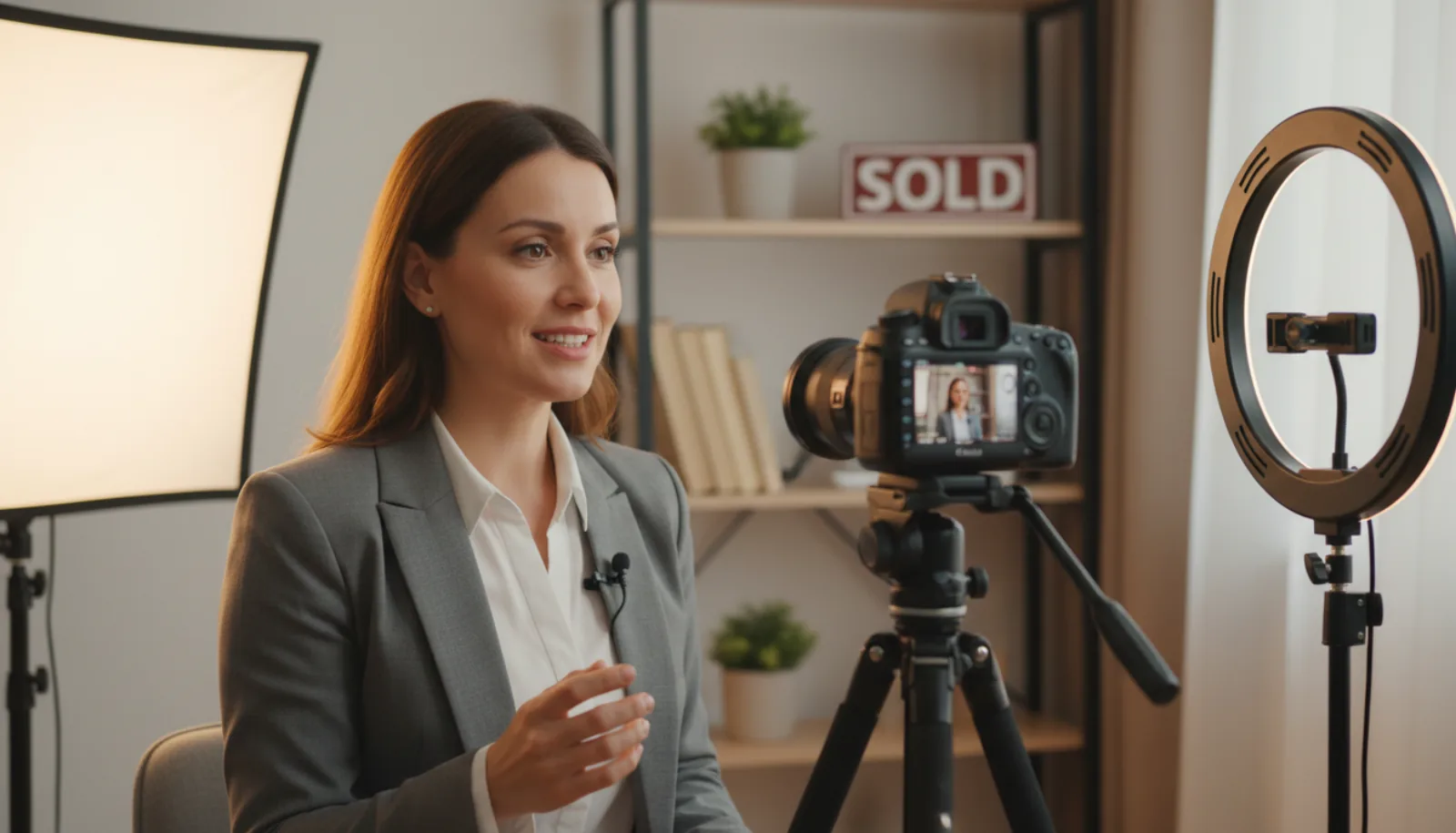
A “ship more reps” recording setup doesn’t need to be elaborate — phone or DSLR, a soft key light, a clean backdrop, and a willingness to publish before it’s perfect:
For a 2026-current breakdown of how the social platforms have actually shifted under agents this year — what’s working now vs. last year’s playbook — Mike Sherrard’s strategy update is one of the more honest takes:
Real estate marketing tactics by goal
Tactics depend on what you’re trying to produce this quarter. Map the goal to the play, not the other way around. The grid below is a working version of real estate marketing tactics that actually move the needle in 2026.
| Goal | High-leverage tactics | Realistic timeline |
|---|---|---|
| More listings (sellers) | Sphere reactivation calls (top 50 in your database, quarterly); just-sold postcard campaign in your farm; case-study video per win; LinkedIn posts targeting referral partners; Zestimate-disagreement direct mail | 60-120 days to first listing |
| More buyer leads | Hyper-local “homes under $X in [neighborhood]” YouTube videos; Google Search ads on long-tail buyer queries; Facebook lead ads with a specific listing as the anchor; Instagram Reels on each new listing | 30-60 days to first qualified showing |
| More closings from existing pipeline | CRM hygiene + automated nurture sequences; weekly “I noticed your saved search” personal outreach; price-drop alerts to anyone who toured; speed-to-lead under 5 minutes for inbound | 30-90 days to convert stale pipeline |
| Brand recognition in your farm | Geo-targeted direct mail (6+ touches/year, same farm); yard-sign saturation; sponsorship of one local recurring event; consistent “agent of [neighborhood]” hyper-local content | 6-12 months to recall, 18-24 to dominance |
| Listing presentation conversion | Pre-listing video tour of recent comparable wins; one-page seller marketing plan PDF; Google reviews above 50; case-study deck with dollar outcomes | 30-60 days to lift win rate |
| Geographic expansion (new ZIP) | Hyper-local market reports; co-listings with established agents in the new area; targeted direct mail; first-listing aggressive marketing as a flagship case study | 12-18 months to be considered “the [ZIP] agent” |
The discipline is picking one row per quarter and resisting the urge to run all six at once. The agents who plateau are the ones running every tactic at 20% effort. The agents who scale run two tactics at 90% and ignore the rest.
Marketing strategies for real estate brokers and brokerages
Marketing for real estate broker roles is a different game from solo-agent marketing. The broker isn’t selling listings — the broker is selling agent productivity, brand consistency, and recruitment. Four areas matter.
Lead distribution. A brokerage’s marketing spend produces a pool of inbound leads. The system that routes those leads — speed-to-lead automation, round-robin vs. performance-tier distribution, accountability dashboards — is the leverage point. Brokerages that fix lead distribution see per-agent production rise without spending another dollar on lead generation.
Agent recruitment marketing. Recruitment is marketing aimed at agents, not consumers. The assets that work: a public-facing “why join us” page with comp structure, tech stack, training calendar, and agent testimonials; a recurring “growth panel” event for licensees in your market; LinkedIn presence from the broker-owner. Most brokerages under-invest here and wonder why their best producers leave for the competition.
Brand consistency across agents. Thirty agents with thirty different headshot styles, thirty different listing presentation decks, and thirty different MLS description voices is a brand problem, not an agent problem. The broker’s job is to provide templated assets — branded video intros, standardized listing photo treatments, a shared description voice — so consumers see one consistent brokerage regardless of which agent they meet. Tools like centralized AI photo enhancement and a shared listing-description style guide solve 80% of this.
Technology stack. A brokerage’s tech stack is a marketing asset. CRM, transaction management, IDX, AI image and video tools, and lead-distribution software collectively determine whether agents spend time on revenue or on admin. Brokerages with a tight stack recruit better and retain better — the tooling itself becomes part of the value proposition.
The mistake most brokerages make is to think of marketing as the consumer-facing brochure. The internal-facing systems — distribution, recruitment, consistency, stack — produce the visible brand the consumer eventually sees.
Tools that pay for themselves
The right tooling separates an agent who runs the playbook in 8 hours/week from one who burns 25 hours/week and still falls behind. The honest 2026 stack — what working agents actually pay for — is below.
| Tool category | Tools | Rough monthly cost | Pays for itself by |
|---|---|---|---|
| CRM | Follow Up Boss, kvCORE, Sierra Interactive, LionDesk | $50-$300 | Speed-to-lead, automated follow-up sequences, source attribution |
| Photo + video AI | BrightShot, Pedra | $19-$49 | One-click virtual staging, decluttering, video assembly |
| Email / SMS | Mailchimp, Constant Contact, ActiveCampaign | $20-$100 | Database nurture, monthly newsletters, automated drips |
| Social scheduling | Later, Buffer, Metricool | $15-$30 | Batch-posting weekly content across IG/TikTok/FB without daily logins |
| Lead-cap landing pages | Carrot, Real Geeks, Placester | $50-$300 | Single-listing pages, IDX search, hyper-local SEO |
| Listing description generator | BrightShot’s free listing description generator | $0 | Cuts MLS copy from 30 minutes to 60 seconds per listing |
| Floor plan / 3D rendering | CubiCasa, iGuide, BrightShot | $10-$50 per plan | Faster MLS submission, premium feel on $500K+ listings |
| Direct mail | Wise Pelican, ProspectsPLUS, Corefact | $0.50-$1.20/piece | Geo-farm dominance, consistent 6-touches/year cadence |
Most agents over-tool: they pay for three CRMs, two photo apps, and an email platform they haven’t logged into in six months. The minimum viable stack is one CRM, one photo/video AI tool, one email platform, one social scheduler. Total: $100-$200/month. Add direct mail when you’ve identified a farm.
🎬 Cut listing prep from 6 hours to 30 minutes. BrightShot’s AI real estate video maker builds cinematic listing videos, vertical Reels, and 360° virtual tours from your existing photos — branded, music-timed, and ready for MLS, Instagram, and TikTok. Pair it with the best virtual tour software breakdown to pick the rest of your stack. Start Free →
Common marketing mistakes that quietly kill agent careers
A short list of patterns we see kill otherwise-talented agents’ marketing efforts.
Posting daily until burnout. The agent who posts five Reels a week for ten weeks and then disappears for six months produces worse results than the agent who posts twice a week for two years. Cadence beats peak frequency. Pick a sustainable rhythm and protect it.
Not tracking attribution. Every lead, every showing, every closing should be tagged in the CRM with its source. Agents who don’t track this can’t tell you which channel produced last month’s commission and end up funding the wrong things. A simple “where did you find me?” question on every intake call is enough to start.
Chasing trends instead of compound channels. Clubhouse, Threads, BeReal — agents who reset their content strategy every time a new platform trends never accumulate compounding audiences. Pick the channels that have lasted 5+ years (Instagram, YouTube, email, direct mail) and ignore the rest.
Under-investing in the sphere. The single highest-ROI channel is the one most agents touch the least. A monthly database email and a quarterly call to the top 50 takes 4 hours/month and produces a third of an experienced agent’s volume. Skip this and you’re leaving money on the table.
Ignoring listing-portal signals. Zillow, Realtor.com, and your MLS dashboard show dwell time, saves, and search-result impressions per listing. Agents who never look at this miss the diagnosis: listings with low dwell time usually have a bad cover photo or a missing video. Check the portal analytics weekly per active listing.
FAQ
What is the best marketing strategy for real estate agents?
For most agents, the best marketing strategy in 2026 is a combination of three compounding channels: a well-executed listing asset stack (pro photos, video, virtual tour, MLS optimization) on every property, a database email program with monthly market updates and quarterly sphere calls, and one consistent social channel (typically Instagram Reels or YouTube) shipped at a sustainable cadence for 12+ months. There is no silver-bullet tactic — the agents who win are the ones who pick a small set of channels and stay disciplined for years while their peers chase trends.
How much should real estate agents spend on marketing?
Industry surveys consistently put the typical solo-agent marketing budget at around 10% of gross commission income, with newer agents skewing higher (15-20%) and established agents with strong referral pipelines skewing lower (5-8%). For an agent producing $100K GCI, that’s $5K-$15K per year — typically allocated as $1.5K-$3K on tools (CRM + photo/video AI + email), $2K-$5K on direct mail or paid ads, and the rest on professional services (photography, videography, headshots). Brokers running multi-agent operations should budget separately for recruitment marketing on top of consumer-facing spend.
How do new real estate agents get clients?
New agents almost universally start from their sphere of influence — friends, family, former coworkers — combined with one listing-marketing flagship that proves they can execute. The fastest path is a published list of 100-200 personal contacts with a recurring quarterly touch (email + direct outreach), one referral or co-listing arrangement with an established agent in the office to learn the workflow, and a single hyper-local content channel (neighborhood YouTube videos, monthly market emails) that compounds over the first 12 months. Paid ads work, but most new agents waste their first $3K-$5K because they don’t have a follow-up system to convert the leads.
What is the 80/20 rule in real estate marketing?
In real estate, the 80/20 rule typically shows up as: 80% of an agent’s transactions come from 20% of their database (the “top 50” — close past clients, repeat referrers, sphere super-fans), and 80% of marketing results come from 20% of channels (almost always: listing portals, sphere/email, and one organic social channel). The strategic implication is to identify your top 20% — both the people and the channels — and over-invest there, rather than spreading thin across every possible tactic. Most agents who plateau are running 10 tactics at 20% effort instead of 2 tactics at 90% effort.
Is paid advertising worth it for real estate agents?
Paid ads work, but only for agents who already have the prerequisites: a follow-up system (CRM with 5-minute speed-to-lead), a clear single-listing or hyper-local landing page, and a measurable cost-per-lead target tied to their average commission. Without those, $3,000/month on Facebook lead ads typically produces 200 unqualified leads, three showings, and zero closings. With them, the same spend can produce 8-15 qualified showings and 1-2 closings/month — a strong ROI. The rule: don’t run paid ads until your organic channels are humming and your CRM is converting at least 1-2% of inbound. Paid is a multiplier, not a starter.