
Traditional home staging costs $1,500 to $5,000 per listing for a typical 60-day contract. Virtual staging costs $19 per month for unlimited listings through subscription tools like BrightShot, or $25-75 per image through pay-per-photo services. That’s the cost spread agents and sellers are weighing every time a vacant property hits the market.
So how much does home staging cost when you actually sit down and do the math? It depends almost entirely on whether you go physical or digital. The traditional route covers consultation, furniture rental, delivery, and a multi-month contract — and it adds up fast. The virtual route uses AI-generated furniture composited into your existing photos, with results that look photorealistic on the MLS and on Zillow. For most listings under $2 million, virtual staging is no longer a budget compromise — it’s the smarter spend.
This guide breaks down the full home staging cost in 2026: what stagers actually charge, what virtual alternatives run, when each approach makes sense, and how to decide which tier your listings need. We’ll cover the average home staging cost by tier, real-world home stager fees, and the per-listing crossover where virtual wins on pure economics.
What Does Traditional Home Staging Cost?
The classic home staging cost breakdown has four moving parts: consultation, furniture rental, labor (delivery + pickup), and the length of the staging contract. Each one stacks on top of the next, which is why a “simple” staging job for a vacant 3-bedroom can quickly clear $5,000.
Here’s how it shakes out in 2026:
- Initial consultation: $200-$500. The stager walks the property, takes measurements, and proposes a furniture plan. Some stagers credit this fee toward the project if you book the full job; others don’t.
- Furniture rental: $1,000-$3,000 per occupied room, per month. The bulk of the cost. Living rooms and primary bedrooms run higher because they need more pieces (sofa, accent chairs, rug, art, lamps, accessories).
- Move-in/move-out labor: $300-$800 combined. Two trips, two crews, sometimes a moving truck rental added on top.
- Contract length: Typically 30-90 days. Most stagers require a 60-day minimum because that’s roughly how long an average listing sits before going under contract. Extensions cost an additional 10-15% per month.
- Geographic variation: Major metros run 30-60% higher. NYC, San Francisco, Los Angeles, Miami, and Boston routinely see staging costs of $6,000-$10,000 for whole-house jobs. Rural and secondary markets often come in under $2,500 for the same property.
According to the National Association of Realtors’ staging report, the average cost to stage a home is around $1,800 for a partial staging package, but full-house jobs for vacant properties — the most common scenario — typically run $3,000-$5,000.
Traditional Home Staging Cost by Tier
To make the cost ladder concrete, here’s how a typical 2,000 sq ft, 3-bedroom vacant home prices out across the three common staging tiers:
| Tier | Rooms Staged | Furniture Quality | Contract Length | Total Cost |
|---|---|---|---|---|
| Entry-level | Living room only | Basic rental inventory | 30 days | $1,500-$2,500 |
| Mid-range | Living, dining, primary bedroom | Mid-tier curated furniture | 60 days | $3,000-$5,000 |
| Luxury | All main living spaces + bedrooms + accents | Designer pieces, custom art | 90 days | $7,000-$15,000+ |
For a $400,000 listing, a mid-range $4,000 staging spend works out to roughly 1% of list price. For a $2 million listing, that same spend is 0.2% — which is why luxury sellers tolerate higher staging budgets. The math gets uglier at lower price points, where staging fees can eat 1.5-3% of the eventual sale price.
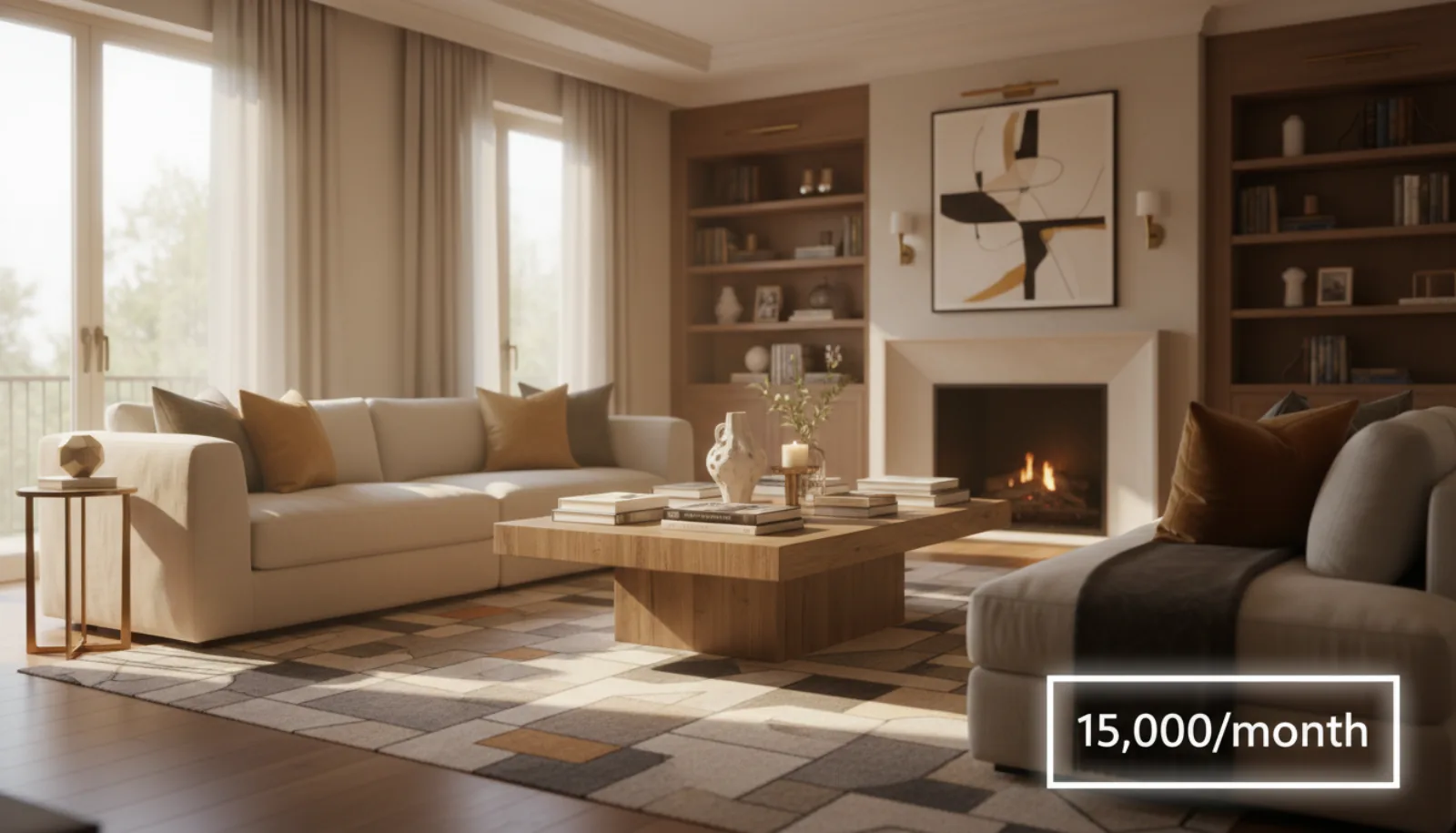
What that mid-range to luxury budget actually buys you in physical inventory — designer furniture, real plants, art, layered textiles — is the half of the cost picture spreadsheets miss:
For a real-world before-and-after walkthrough of a traditional staging job — what changes between empty and staged, and what it actually feels like as a buyer touring the property — Vanessa’s full house tour is one of the more useful video versions of this comparison:
Home Stager Fees: Hourly, Daily, Per-Listing
Home stager fees come in three structures, and which one you encounter depends on the stager’s business model and your project scope.
Hourly rates typically run $50-$150/hour. You’ll see hourly billing for consultations, walk-throughs, and “redesign” services where the stager works with the seller’s existing furniture. Most consultations are billed at 2-3 hours minimum.
Daily rates run $400-$1,200/day. Less common in residential staging, more common when a stager is brought in for a single styling day on an occupied home or for refresh work between offers.
Per-listing flat fees are the dominant model for vacant homes. The stager bundles consultation, furniture, delivery, styling, and pickup into a single quote, usually with a 30, 60, or 90-day contract baked in. Per-listing fees are how most home stagers cost out a job today because it gives the seller a predictable number to plan around.
The home stager cost also varies dramatically based on whether the property is occupied or vacant:
- Vacant home staging fees: $2,500-$8,000 for a full house. Higher because the stager is bringing in every piece of furniture, art, lamp, rug, and accessory. The home staging fee here covers a complete furniture rental contract.
- Occupied home staging fees: $500-$2,000. Lower because the stager works with what’s already there — rearranging, removing clutter, adding a few accent pieces. Sometimes called a “soft stage” or “redesign.”
These home stagers cost ranges hold for most US markets. Coastal metros and luxury submarkets push into the upper bounds; small-town and exurban markets run at the lower end. Always get three quotes — the variance between stagers covering the same zip code is often 40% or more.
How Much Does Virtual Staging Cost?
Virtual staging cost runs an order of magnitude lower than traditional staging because there’s no furniture to rent, no truck, no crew, no contract minimum. You upload a photo of an empty room, the AI generates photorealistic furniture composited into the scene, and you download the result in under a minute.
The market splits into three pricing models:
Per-image services. You pay for each staged photo. Typical pricing:
- BoxBrownie: $25-75 per image, depending on style complexity and revisions
- VirtualStagingAI: $0.39-$29 per image depending on plan tier
- Stuccco: $29 per image for standard turnaround
- Spotless Agency: $19-$39 per image
Subscription services. Flat monthly fee, generous or unlimited usage:
- BrightShot: $19/month for the basic plan with 80 images, scaling up to higher tiers — works out to roughly $0.24 per staged photo at the entry plan, dropping further as you upgrade
- Apply Design: ~$15-$30 per image with credit packs
- Roomvo / Styldod: Per-image pricing with volume discounts
DIY tools. Free or near-free, but quality and turnaround vary widely. Most agents who try DIY end up moving to a subscription tool within a few months.
The pricing crossover happens almost immediately. Even at the highest per-image tier, you only need to virtually stage about three photos to match a single month of BrightShot’s $19 subscription. For agents pushing more than two listings a year, subscriptions are simply cheaper.
Virtual Staging Cost vs Traditional: Portfolio Crossover
Here’s where the gap becomes impossible to ignore. We modeled three real-world portfolio sizes — 5, 10, and 50 listings annually — at average staging spend levels:
| Portfolio Size | Traditional Staging | Virtual Staging (BrightShot $19/mo) | Virtual Staging (per-image at $30/photo) | Savings vs Traditional |
|---|---|---|---|---|
| 5 listings/yr (10 photos each) | $20,000 | $228 (full year) | $1,500 | $18,500-$19,772 |
| 10 listings/yr (10 photos each) | $40,000 | $228 (full year) | $3,000 | $37,000-$39,772 |
| 50 listings/yr (10 photos each) | $200,000 | $588 (premium tier annual) | $15,000 | $185,000-$199,412 |
The crossover point where virtual staging beats traditional on raw cost is less than two listings per year. After that, traditional staging stops being a budget item and starts being a luxury choice — one you’d only make for very specific listings.
For an honest “is staging actually worth the cost?” gut-check with real before/after photos at a working price point — not luxury or virtual, just the typical mid-market case most agents will face — Orange County Living’s review is the cleanest 10-minute version of the question:
Traditional vs Virtual Staging: When Each Wins
Cost isn’t the only factor. There are listings where physical staging genuinely earns its price, and listings where virtual is the obviously correct choice. Here’s the decision framework most successful agents have landed on by 2026.
Traditional staging wins when:
- Luxury listings above $2M. Buyers in this range often tour multiple high-end properties in a single weekend. Empty rooms — even with great virtual photos online — feel cold in person. The 0.2-0.5% staging spend is rounding error against the sale price.
- You’re already booked for an in-person photoshoot anyway. If the photographer needs furniture in frame for proper scale, and the seller is willing to pay, physical staging makes the photoshoot smoother.
- The buyer experience needs to be high-touch. Open houses, broker tours, and serious in-person showings all benefit from real furniture. Virtual staging can’t help an empty room feel warm during a tuesday afternoon walkthrough.
- The home has unusual proportions or layouts. Buyers struggle to picture furniture in a 22-foot-long galley living room or a triangular bedroom. Physical pieces solve the spatial confusion that even great virtual staging can’t fully address.
Virtual staging wins when:
- Listings under $2M. This is the bulk of the US housing market. Virtual staging delivers the same MLS-photo impact as traditional at less than 1% of the cost. The math is brutal here.
- You handle high portfolio volume. 10+ listings per year? You cannot afford traditional staging on each one. You need a tool that scales without scaling cost.
- Vacant homes that need to look move-in ready online. Virtual staging excels at creating the “this could be your home” moment in a portal scroll. That’s where 90% of buyers form their first impression.
- Time-constrained agents. Traditional staging requires 1-2 weeks of lead time (consultation, scheduling, delivery). Virtual staging takes minutes. If a listing is going live Friday, virtual is your only realistic option.
- MLS, Zillow, and portal photos. Online photos do not benefit from real furniture in the room — only from furniture in the photo. Virtual staging handles that 100%.
The goal of staging — physical or virtual — is to help a buyer picture their life in the home. Photos do that 95% of the time. In-person walk-throughs do it the other 5%. Match your spend to where the buyer actually decides.
For agents who already have furnished photos but want to swap out dated decor, the smart move is to first remove the existing furniture before staging fresh. BrightShot’s photo decluttering and furniture removal tool handles that step in seconds.
Hidden Costs to Watch Out For
The headline home staging cost numbers don’t always include the surprises that show up in real-world projects. Both sides have them.
Traditional staging hidden costs:
- Theft and damage on vacant properties. Staged vacant homes are targets. Insurance riders for staged inventory typically add $50-$200/month, and theft deductibles can be $500-$2,500 per incident.
- Late-return fees. If the home doesn’t sell in your contracted 60 days and you extend month-to-month, expect 10-15% rate increases. Some stagers charge a flat reinstall fee if you let furniture come back and then need it again.
- Restocking fees on cancellation. Backing out of a staging contract early often triggers a 25-50% cancellation fee.
- HOA and condo restrictions. Some buildings require staging crews to use freight elevators only, with elevator-reservation fees of $100-$500 per use.
Virtual staging hidden costs:
- Subscription lock-in. Annual plans look cheaper monthly but commit you for 12 months. Always check whether you can downgrade mid-cycle.
- Revision fees on per-image services. BoxBrownie and similar shops charge $5-$20 per revision after the first round. If your photographer’s lighting is off, revisions add up.
- Resolution and licensing limits. Some virtual staging tools watermark output or limit you to 1080px exports on free tiers. Check that any plan you pick delivers MLS-compliant resolution (typically 2048px or higher) without watermark.
The good news on virtual: most of these hidden costs are avoidable by reading the plan terms once. The traditional staging hidden costs tend to be unavoidable consequences of the physical-furniture model.
What Should You Actually Pay?
Here’s the straight answer based on your listing volume and price points:
1-2 listings per year. Skip traditional staging entirely unless the home is over $2M. Use a $19/month virtual staging tool like BrightShot for the months you have a listing live, then cancel between listings. Total annual spend: under $50.
3-10 listings per year. A virtual staging subscription saves you thousands. At even mid-range traditional staging ($4,000/listing), you’d be spending $12,000-$40,000/year. A $19-$50/month virtual subscription handles every listing for under $600/year, freeing budget for marketing, photography, and lead generation.
10+ listings per year. Virtual staging is the only economically viable option. Traditional staging would mean $40,000-$200,000 in annual staging spend — money that’s better deployed on agent marketing, broker leads, or tools like video tours that convert viewers further down funnel. Reserve traditional staging for the 1-2 luxury listings per year where the price point justifies it.
The honest truth: most agents in 2026 should default to virtual and treat physical staging as the exception. The economics simply don’t work the other way around anymore.
For a deeper look at preparing photos before staging, our guide on decluttering a home for sale walks through removing existing furniture, personal items, and visual noise so virtual staging composites cleanly into the room.
Try Virtual Staging Free
The fastest way to see whether virtual staging fits your workflow is to stage a real listing photo and compare the result side-by-side with what traditional staging would deliver.
Stage rooms with photorealistic furniture in 15 seconds — Try BrightShot’s virtual staging tool. Upload a photo of an empty room, pick from over 80 interior design styles (modern, coastal, farmhouse, Scandinavian, and more), and download an MLS-ready staged photo. The free tier includes 3 image credits with no credit card required.
Already have furnished photos? Remove the existing furniture first. Use BrightShot’s AI photo declutter and furniture removal to clear the room before re-staging it in a fresh style. This is especially useful for occupied listings where the seller’s furniture doesn’t match the buyer demographic.
For full pricing tiers and feature comparisons, see BrightShot’s pricing page. Plans start at $19/month and include virtual staging, decluttering, lighting enhancement, sky replacement, day-to-dusk conversion, and AI video tours — everything you’d otherwise piece together from three or four separate tools.
Frequently Asked Questions
How much does it cost to stage a house?
Traditional home staging costs $1,500-$5,000 per listing for a 60-day contract on an average-sized home, with luxury staging running $7,000-$15,000+. Virtual staging is dramatically cheaper at $19/month for unlimited photos through subscription tools, or $25-75 per image through pay-per-photo services. The cost to stage a home depends primarily on whether you go physical (high cost, in-person impact) or virtual (low cost, online impact).
Do home stagers charge by the hour?
Some do, especially for consultations and “redesign” services where they work with existing furniture. Hourly home stager fees typically run $50-$150/hour. However, the dominant pricing model for vacant home staging is a per-listing flat fee that bundles consultation, furniture rental, delivery, styling, and pickup into a single quote. Daily rates of $400-$1,200/day exist but are less common in residential real estate.
Is virtual staging cheaper than traditional?
Yes, by an order of magnitude. Traditional staging averages $3,000-$5,000 per listing, while virtual staging runs $19/month for unlimited listings on subscription tools or $25-75 per individual image on pay-per-photo services. The crossover where virtual saves money is less than two listings per year. For any agent handling 3+ listings annually, virtual staging saves thousands.
What’s the average home staging fee for vacant homes?
Vacant homes typically cost $2,500-$8,000 to stage traditionally because every piece of furniture, art, rug, and accessory must be brought in. The home staging fee scales with property size and number of rooms staged — a 1-bedroom condo can stage for under $2,000, while a 5-bedroom luxury home easily exceeds $10,000. Virtual staging delivers the same online impact for vacant homes at less than 1% of these costs.
Does staging actually pay for itself?
According to NAR data, staged homes sell faster and often at higher prices than comparable unstaged homes — typical figures cited are 5-10% above list and 30-50% faster time-on-market. Whether the staging fee pays for itself depends on the price point: at $400,000 with $4,000 staging spend, you need a 1% lift to break even. At $2M with the same spend, you need 0.2%. Virtual staging shifts the math even further in the seller’s favor because the input cost is so much lower.
Ready to stage your next listing without the $5,000 furniture rental contract? BrightShot delivers photorealistic virtual staging in 15 seconds, with over 80 interior styles, MLS-ready resolution, and no per-image fees. Start with 3 free credits — no credit card required.


