When agents ask how to generate real estate listings, they usually mean one of two related things — and confusingly, the same Google search returns answers to both. The first is generating listing descriptions: writing the 250-400 word MLS narrative that actually goes on the listing page. The second is generating prospective listings: sourcing the off-market sellers who will eventually sign a listing agreement. Both are real workflows, both are now AI-augmented in 2026, and both are covered below — Path A for the description, Path B for the lead.
We get the question constantly because the listing description has quietly become the highest-friction part of a modern listing workflow. Photos take an hour with a good photographer; video takes 90 minutes; the description used to take 30-45 minutes of staring at a blank MLS field trying to remember whether “cozy” is a fair-housing trap word (it’s not, but “exclusive neighborhood” is). The AI listing-description generators that came online in 2024-2025 collapse that 30 minutes to about 60 seconds — which is why every working agent should have one bookmarked.
The lead-sourcing side is older, slower, and unglamorous. It’s where the actual listings come from, and it doesn’t change much year to year. We’ll cover both in this post so you can put the right one to work depending on what you’re actually trying to solve this week.
Path A: Generate listing descriptions with AI
A high-converting MLS listing description has five components, in roughly this order. Skipping any of them is what makes a description feel generic.
- Location anchor. The neighborhood, school district, walk score, or geographic feature that buyers searched for to land here. “Tucked into the foothills of the East Side Highlands School District…”
- Architectural / structural facts. Year built, square footage, bed/bath, lot size, recent renovations. The non-negotiables a buyer needs to qualify the home.
- Standout features. The 3-5 specific things that separate this listing from comparable ones. Not “spacious kitchen” — “a 9-foot quartz waterfall island with a 36-inch gas range and a hidden walk-in pantry.”
- Lifestyle framing. The day-in-the-life hook that helps buyers picture themselves there. “Mornings on the south-facing back deck; evenings in the sunken living room with the original 1972 stone fireplace.”
- Call to action. The final 1-2 sentences that prompt a showing request. Most agents skip this entirely. Don’t.
Skip any of these and the description reads like every other listing on the MLS. Hit all five and the listing earns longer dwell time on portals, which is the underlying signal that drives more saved searches and more inquiries.
The 4-step AI listing description workflow
This is the actual end-to-end flow for how to generate a real estate listing description in 2026, start to finish:
Step 1 — Capture the inputs. Before opening the AI tool, gather the basics: address, bed/bath/sqft, lot size, year built, 3-5 standout features in plain English (“just-renovated kitchen,” “primary suite with new soaking tub,” “fenced backyard for dogs”), the buyer profile you’re targeting, and 5-8 photos of the strongest rooms. Most agents do this in a 2-minute voice memo on the way back from a showing.
Step 2 — Run the inputs through a generator. Paste the inputs into a listing description tool. We’re biased (we built one), but BrightShot’s free listing description generator will produce a 250-350 word MLS-ready description in about 60 seconds with no signup. ChatGPT and Claude work fine too if you write a strong prompt; Pedra has a free version. The output won’t be perfect on the first pass — that’s expected.
Step 3 — Edit for voice and accuracy. Read the output line by line. Fix anything technically wrong (wrong school district, wrong square footage). Cut hype words (“luxurious,” “stunning,” “breathtaking”) and replace them with specifics (“south-facing,” “soft-close cabinetry,” “60-foot lap pool”). Add the one detail only you noticed at the showing — the tree that flowers in April, the breakfast nook that gets perfect morning light. The AI can’t know that; you can.
Step 4 — Publish to the MLS, single-listing site, and email blast. A good description gets reused four ways — MLS narrative, single-property landing page, just-listed email blast, and the caption for the just-listed Reel. One generation, four channels. Don’t write four separate versions.
The whole loop takes 10-15 minutes start to finish, versus 30-45 with a blank MLS field. For agents who list 10-30 properties a year, that’s 5-15 hours back per year — enough time for two extra listing presentations.
✍️ Generate a property description in 60 seconds — no signup. BrightShot’s free listing description generator takes your bed/bath/sqft and 3-5 features and writes an MLS-ready 250-350 word description with location anchor, lifestyle framing, and a real call to action. Edit, copy, paste — done. Try the free generator →
Anti-patterns to avoid in any AI-generated listing description
Three patterns that quietly kill conversions and that AI tools, left unchecked, will produce by default:
- Generic adjectives. “Stunning,” “luxurious,” “charming,” “breathtaking,” “must-see.” These words are so over-used on the MLS that buyers’ eyes skip them. Replace with specifics.
- ALL CAPS WORDS. “STUNNING KITCHEN!! MUST SEE!!” reads as low-trust. The MLS isn’t an eBay listing.
- Fair-housing trap language. Phrases like “exclusive neighborhood,” “great for families,” “walking distance to churches,” or “perfect for empty-nesters” can run afoul of the Fair Housing Act because they imply a preferred occupant class. Stick to property features, not occupant types. When in doubt, ask your broker’s compliance team.
The mechanical part — open editor, paste features, generate, edit, ship — looks like this in practice:
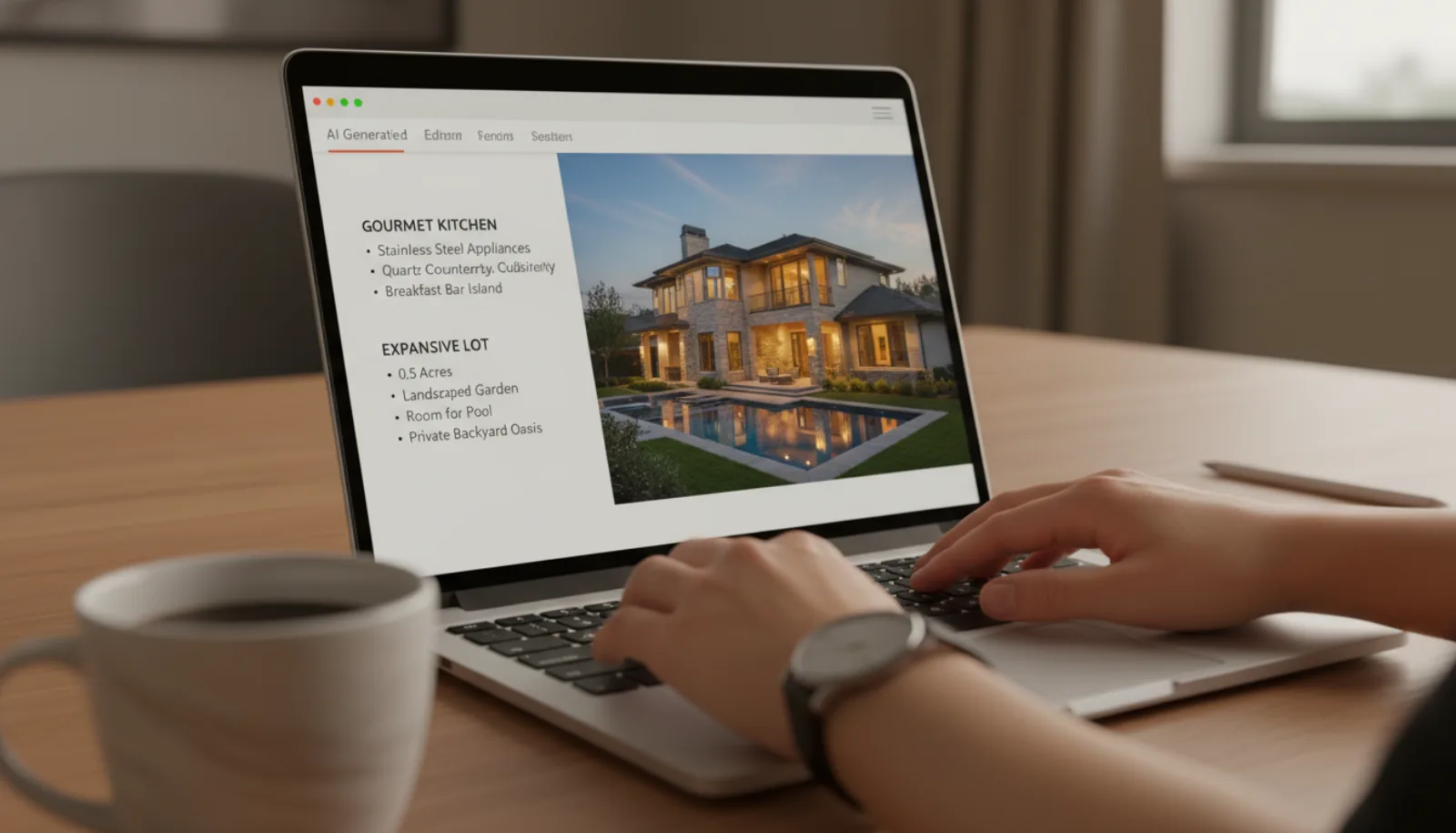
For the manual side of the craft — headlines, openers, bios, and the small editing moves that lift a description from generic to convertible — Coach Carmine’s full copywriting walkthrough is the most thorough single video on the topic:
Path B: Generate listing leads (off-market sourcing)
Path A solves the description problem; Path B solves the harder, longer problem of finding sellers in the first place. There is no AI shortcut here yet — listings come from people, and the channels that produce them are unsexy and compounding.
The honest 2026 stack for how to generate real estate listings as actual seller leads — not just descriptions — is six channels deep. Most agents try to run all six at 20% effort and produce nothing; the agents who scale pick two and run them at 90% for 12+ months.
1. Sphere of influence (SOI)
The single highest-ROI channel, full stop. NAR’s annual data consistently shows that referrals and repeat business produce roughly a third of an experienced agent’s transactions. Mechanic: keep a current database of 100-300 names (friends, family, past clients, former coworkers, your accountant), email it monthly with a useful market update, and call your top 50 once a quarter. Cost: $20-$100/mo for the email tool. Most agents skip this because it doesn’t feel like “marketing.” It is the marketing.
2. Geographic farming and direct mail
Pick a 200-500 home neighborhood with a 5-7% annual turnover rate, become the agent there, and send 6+ direct-mail touches per year. At $0.50-$1.20 per postcard times 500 homes times 6 mailings, that’s $1,500-$3,600/year — less than two months of paid social, and it produces sellers who already know your name. The 12-month delay is what scares most agents off; the agents who stick with it own their farm by year three.
3. Expired and withdrawn listings
A homeowner whose listing just expired or was withdrawn is, by definition, a motivated seller whose previous agent didn’t perform. They’re hard to call (you’re competing with every other agent in the market within 24 hours), but the conversion rates are the highest of any cold source. Lead with value: a fresh CMA, a one-page marketing review of why the listing didn’t move, and zero hard pitch. The first call is to schedule the second call.
4. Open house attendee follow-up
Most agents treat the open-house signup sheet as a formality. The agents who consistently generate listings from open houses do three things differently: they follow up within 48 hours with a personalized email referencing what the attendee said at the door, they tag the lead source in the CRM so they can track conversion, and they re-engage at 30 / 60 / 90 days with comparable listings. Open-house attendees who don’t buy that house become the seed corn for buyer-side commissions and, eventually, listing-side referrals.
5. Online lead-capture landing pages
A single-purpose landing page with one offer (“get a free home valuation in your ZIP”) and one form (address, name, email — no phone) will outconvert your homepage 5-10x for paid-traffic. Pair it with $300-$1,500/month of Google Search ads on long-tail seller-intent queries (“homes sold in [neighborhood] last 90 days,” “what is my home worth in [ZIP]”), and you have a measurable cost-per-lead. Most agents waste their first $3K-$5K because they don’t have a follow-up system; the system matters more than the ad spend.
6. “Just listed / just sold” social cadence
Every listing event — going active, going pending, closing — is a free unit of social content. The agents who win at this don’t post about themselves; they post about the listing, with a specific number (“sold $40K over asking in 6 days”) and a specific neighborhood. Two posts per listing, across IG / FB / TikTok, builds a local audience that compounds over 12-24 months. See our real estate marketing guide for agents for the full distribution playbook.
The discipline is the same on Path B as Path A: pick two channels you can execute consistently for a year, ignore the rest. The agents who plateau are the ones running six tactics at 20% effort instead of two at 90%.
What “consistent execution” actually looks like at the desk — phone in hand, CRM up, sticky notes with the morning’s call list:

For the long-term play — using YouTube as an evergreen seller-lead channel rather than a social platform — the Passive Prospecting walkthrough is the cleanest version of the system that has produced eight-figure listing pipelines for individual agents:
What makes a property description rank and convert
A listing description does two jobs at once. It needs to satisfy the MLS / portal algorithm enough to surface in saved searches, and it needs to convert the human who clicks through. Most agents optimize for one and ignore the other.
Algorithmic signals (Zillow, Realtor.com, MLS): keyword density on bed/bath/feature terms, length (250-400 words is the sweet spot — shorter looks lazy, longer gets truncated), freshness (descriptions edited 2-3 times during an active listing tend to outperform untouched ones), and structured data completeness (filling every MLS field, not just the description). Algorithms don’t read the way a buyer does, but they correlate dwell time and saves with the descriptions that perform — so the human-conversion side feeds back into ranking.
Conversion signals (the buyer reading on their phone at 11pm): specific numbers (“9-foot ceilings,” “0.34-acre lot,” “240V outlet in the garage”), lifestyle framing that matches the target buyer profile, scarcity cues that are real (not “won’t last!” — actual things like “only 3 listings on this street this year”), and a final-paragraph call to action that prompts a tour request. Specific outperforms generic in every test we’ve ever run.
For commercial real estate, the math shifts: cap rate, NOI, lease terms, and tenant quality replace lifestyle framing. The five-component structure stays the same, but components 3-4 swap from “standout amenities and lifestyle” to “investment thesis and tenant mix.” Same skeleton, different flesh.
Common listing-description mistakes
A short list of patterns we see kill otherwise-decent descriptions:
- Opening with the address. Lead with a hook, not a street name — buyers have already seen the address in the listing header.
- Stuffing every adjective on the MLS feature list (“luxurious modern stunning sun-drenched”). Pick one strong word per sentence, max.
- Listing every appliance brand. Buyers care about three: range, fridge, dishwasher. Name those; skip the rest.
- Forgetting the call to action. “Schedule a private tour” should be the last sentence of every description.
- Fair-housing trap language. “Exclusive,” “ideal for families,” “great church community,” “perfect for empty-nesters.” Stick to features, not occupants.
- ALL CAPS. Reads as desperate.
- No paragraph breaks. A wall of 350 words is unreadable on a phone — break it into 3-4 short paragraphs.
- Copy-pasting the previous listing. Every description should be specific to the property. The MLS catches duplicates and downranks them.
- Misrepresenting features. “Move-in ready” on a home with deferred maintenance is a lawsuit waiting to happen.
- Skipping the neighborhood. Buyers searching by ZIP need the geographic anchor; without it, you lose half the saved-search traffic.
FAQ
How do you generate real estate listings?
There are two distinct workflows that go by this name. To generate a listing description (the MLS narrative), gather the property’s bed / bath / sqft / lot size, 3-5 standout features, and a target buyer profile, then run them through an AI listing description generator (BrightShot has a free one) to produce a 250-350 word draft in about 60 seconds. Edit for voice, accuracy, and one specific detail only you noticed at the showing, then publish to the MLS, your single-property landing page, and your email blast. To generate listing leads (sellers who will eventually sign with you), commit to two of the six channels that actually produce sellers — sphere of influence, geographic farming with direct mail, expired and withdrawn listings, open-house attendee follow-up, online lead-capture landing pages, and just-listed / just-sold social — and run them at 90% effort for 12 months minimum. Both workflows compound; both reward consistency over creativity.
What is the best AI listing description generator?
For most agents, the right answer in 2026 is whichever generator is built specifically for real estate (so it knows about fair-housing language, MLS length conventions, and the five-component structure) and has a free tier you can test. BrightShot’s free listing description generator is the no-signup option; ChatGPT and Claude both produce strong descriptions if you write a tight prompt that specifies length, structure, and target buyer; Pedra and PhotoUp also have real-estate-specific generators. Avoid generic copywriting tools that don’t know about fair-housing trap language — the legal exposure isn’t worth the small quality difference.
How long should a real estate listing description be?
The sweet spot for residential MLS descriptions is 250-400 words. Shorter than 250 reads as lazy and under-merchandised; longer than 400 gets truncated on portal display and stops being read. The common 150-word “starter” descriptions you see on under-marketed listings consistently underperform on portal dwell time and saved searches. For commercial real estate, 350-550 words is more typical because of the additional financial detail (cap rate, NOI, tenant mix). For luxury listings above $2M, 400-500 words with a stronger lifestyle narrative is appropriate — the buyer profile expects more.
Can I use AI-generated listing descriptions on the MLS?
Yes. The MLS rules in every US market we’re aware of govern what you can claim about a property — accuracy of square footage, lot size, school district, recent renovations — not who or what wrote the description. AI-generated descriptions are no different from descriptions written by a brokerage assistant or a copywriter, as long as the agent of record reviews and stands behind every factual claim. The legal risk is misrepresentation, not authorship. The practical workflow is: generate the draft with AI, edit it for accuracy and voice, and the licensed agent signs off before it hits the MLS — exactly the same review you’d do for a human-written description.
What words should you avoid in a real estate listing?
Two categories. The first is the fair-housing trap words: any phrase that implies a preferred occupant class on the basis of race, color, religion, sex, familial status, national origin, disability, or — in some states — sexual orientation, gender identity, or source of income. Concrete examples: “exclusive,” “great for families,” “ideal for empty-nesters,” “walking distance to churches,” “safe neighborhood,” “no children,” “perfect for singles.” The HUD guidance is to describe the property, not the occupant. The second category is hype words that sound impressive but signal low-effort writing: “stunning,” “luxurious,” “charming,” “breathtaking,” “must-see,” “won’t last,” “priced to sell.” Buyers and AI ranking systems alike have learned to skip them. Replace each with a concrete specific — “south-facing 12-foot deck” beats “stunning outdoor space” every time.