The right equipment for real estate photography in 2026 falls into one of three spend tiers. A starter kit at around $500 gets a used mirrorless body, a kit ultra-wide, and a basic tripod — enough to shoot $300k listings without embarrassing yourself. The mid-tier kit at $2,000 adds a current full-frame body, a sharp 16-35mm equivalent, two speedlights, and a sturdier tripod head — the working pro standard. A pro setup at $5,000+ layers in a tilt-shift lens, a couple of strobes with modifiers, a DJI Mini 4 Pro drone, and a Ricoh Theta Z1 for 360 tours.
There is also a fourth path that didn’t exist three years ago: skip half the lighting gear and use AI to fix exposure, brightness, and color in post. A single Canon body, a wide lens, and a tripod paired with BrightShot’s lighting enhancement gets you 90% of the result of a full strobe setup at 10% of the cost. This guide walks through every piece of gear worth buying — camera, lenses, tripod, lighting, drone, 360 rig, accessories — with rough 2026 prices, then shows three complete kits and the AI shortcut that lets you spend less without looking it. If you’re still figuring out the shoot itself, our companion how to take real estate photos walks through the 6-shot template, DSLR settings, and iPhone alternative.
Essential equipment for real estate photography
Before pricing individual pieces, here’s the full shopping list. Every working real estate photographer carries some version of this kit:
- Camera body — full-frame mirrorless or DSLR, 24 MP minimum
- Ultra-wide-angle lens — 16-35mm equivalent on full-frame, or 10-20mm on APS-C
- Tripod with leveling head — Manfrotto 055, Gitzo Mountaineer, or Really Right Stuff TVC-24L
- Two speedlights or one strobe — Godox V1 or AD200 Pro for off-camera flash
- Light stands — two compact 8-foot stands minimum
- Remote shutter or tethered laptop — for vibration-free brackets
- Color checker or grey card — X-Rite ColorChecker Passport
- Spare batteries and high-speed SD cards — three batteries, two 64 GB cards
- Camera bag — Peak Design Everyday Backpack or Think Tank Airport
- Drone — DJI Mini 4 Pro for sub-249g exemption, or Mavic 3 Pro for serious aerial work
- 360 camera — Ricoh Theta Z1 or Insta360 X3 for virtual tours
The total list price for the pro version of this kit lands between $5,000 and $7,500 depending on lens choices. The smart-budget version using AI editing for lighting comes in under $2,500.
The rest of this guide breaks down what to buy in each category, what to skip, and where the “spend more” actually pays off in faster shoots or better images.
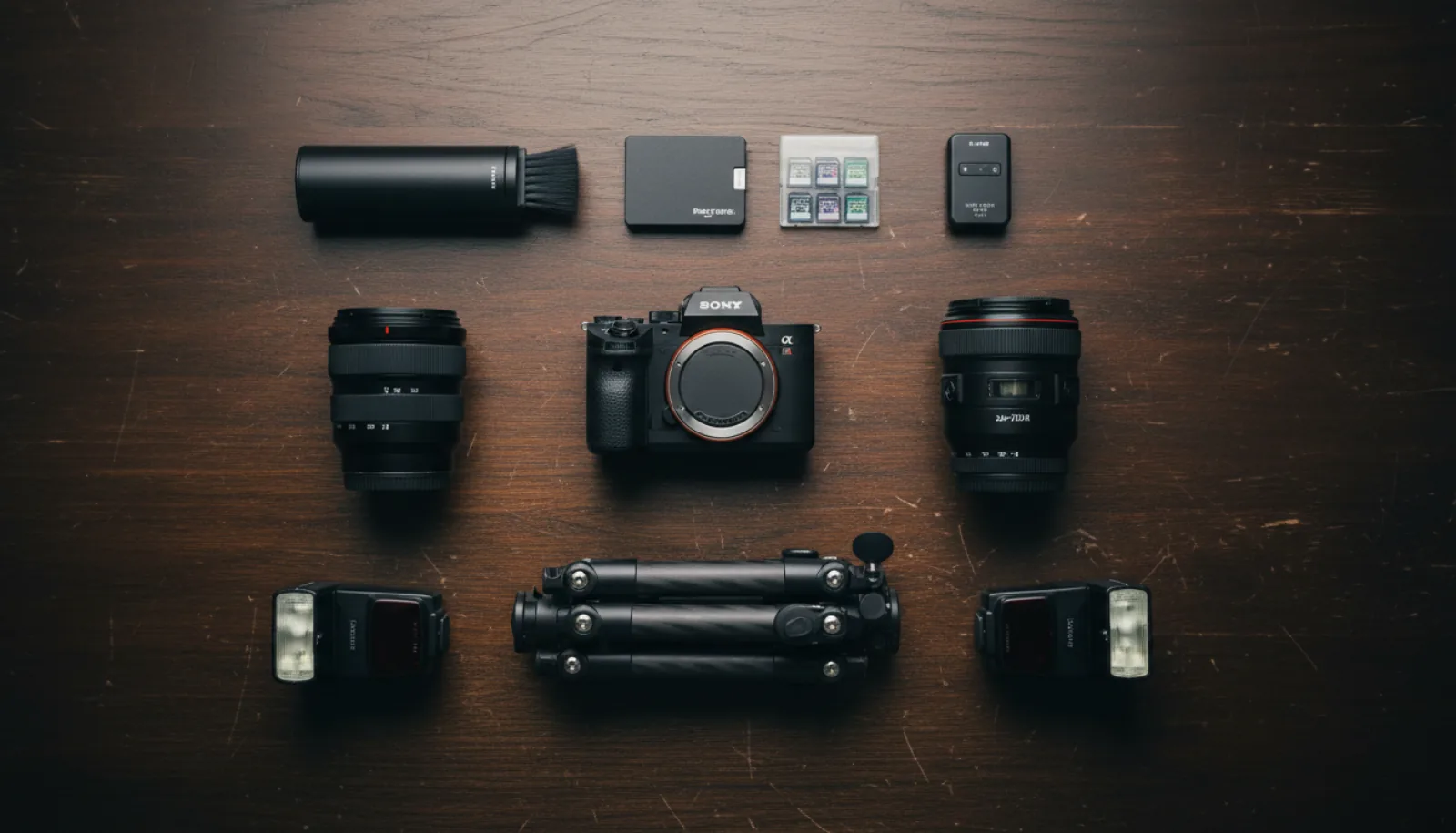
Laid out flat, this is roughly what a working real estate photographer carries onto every shoot:
For a 2026-current breakdown of which specific bodies and lenses are actually worth the spend right now — budget tier vs. working-pro tier — this gear comparison is one of the more honest ones on YouTube:
Cameras
The body is where most photographers overspend. A used Canon 6D Mark II at $700 produces real estate images indistinguishable from a $3,500 Canon R5 once both files are processed and exported at web resolution. The features that matter for interiors — high dynamic range, clean shadow recovery, a tethered live view — are present in every full-frame body made since 2017.
The three mainstream picks for 2026:
- Canon EOS R8 ($1,500) — 24 MP mirrorless, the same sensor as the R6, lightweight enough for a full day of shoots
- Sony a7 IV ($2,500) — 33 MP, deepest mirrorless lens ecosystem, best autofocus for video walkthroughs
- Nikon Z6 II ($1,800) — 24 MP, excellent dynamic range, the Z 14-30mm f/4 pairing is one of the sharpest ultra-wides made
For a deeper breakdown of bodies, used vs new pricing, and DSLR-vs-mirrorless tradeoffs specific to real estate work, see our camera for real estate photography guide. The summary: at any tier, full-frame beats crop sensor, and a used current-generation body beats a new entry-level one.
One spec to ignore: megapixels above 30. Listing photos get exported at 2048px wide for MLS and 1920px for portfolio sites. A 24 MP file is already 4x the resolution you need.
Lenses for real estate photography
The lens matters more than the body. A $500 ultra-wide on a $700 used body will out-shoot a $1,500 mid-zoom on a $3,000 body every time, because real estate is a wide-angle game.
Ultra-wide zoom (the only required lens)
You want roughly 16-35mm equivalent on full-frame. Wider than 16mm produces obvious barrel distortion that makes rooms look funhouse-shaped; longer than 35mm doesn’t cover small bedrooms or bathrooms.
Native picks by mount:
- Canon RF 15-30mm f/4.5-6.3 IS STM ($550) — the budget RF ultra-wide, sharp enough at f/8
- Canon EF 16-35mm f/4L IS ($700 used) — the workhorse for 5D Mark IV / 6D Mark II shooters
- Sony 16-35mm f/4 PZ G ($1,200) — internal zoom, weather-sealed
- Tamron 17-28mm f/2.8 Di III RXD ($800) — the budget Sony alternative, exceptionally sharp
- Nikon Z 14-30mm f/4 ($1,300) — wider than the others, takes 82mm filters
- Sigma 14-24mm f/2.8 DG DN Art ($1,300, Sony E / Leica L) — overkill for real estate but a fantastic lens
If you only buy one lens, this is it. Stop down to f/8-f/11 for interiors, f/11 for exteriors. Edge-to-edge sharpness at f/4 doesn’t matter when you’re at f/8 on a tripod.
Tilt-shift lens (pro option)
A tilt-shift lens lets you correct vertical perspective in-camera instead of in post. Walls stay parallel without cropping or warping. The two real options:
- Canon TS-E 17mm f/4L ($2,150) — the gold standard for high-end real estate and architectural work
- Nikon PC-E 19mm f/4E ED ($3,400) — Nikon’s equivalent, sharper at the edges
Tilt-shifts are slow to use (manual focus, manual aperture) and overkill for $300k MLS listings. They earn their keep on $2M+ properties where the photographer charges $800+ per shoot. Skip until you’re shooting two of those a month.
Don’t bother with
- Fisheye lenses — distortion is wrong for real estate. Use a rectilinear ultra-wide instead.
- Standard zooms (24-70mm) — only useful for detail shots, which most agents don’t pay for.
- Prime lenses for interiors — fast apertures don’t help when you’re at f/8 on a tripod. Save the money for a second flash.
Tripod and head
The tripod is the second-most-important piece in your real estate photography kit. A wobbly tripod ruins HDR brackets — every misaligned frame is a frame you can’t merge cleanly. Spend real money here. A good tripod lasts 15 years; a bad one gets replaced in 18 months.
What you actually need:
- Maximum height — 65 inches minimum, so you can shoot bedroom-eye-level (around 4.5 feet from the floor) on stable middle leg sections
- Load capacity — 15 lbs at minimum, so a heavy body + flash bracket doesn’t sag
- Independent leg locks — for setting up on stairs and uneven terrain
- Removable center column — so you can flip it horizontal for low-angle kitchen shots
Solid picks by tier:
- Manfrotto 055XPRO3 ($300) + Manfrotto 410 geared head ($350) — the working real estate tripod. Geared head lets you nudge framing by fractions of a degree.
- Gitzo GT2542 Mountaineer ($900) + Arca-Swiss D4 ($1,100) — what high-end architectural shooters use. Carbon fiber, 30+ years of service life.
- Really Right Stuff TVC-24L ($1,250) + BH-55 ball head ($475) — overkill for most real estate, but the build quality is unmatched.
- Budget pick: Manfrotto Befree Advanced ($200) — travel tripod, light enough to carry on three-house days, sturdy enough for 24 MP bodies
The head matters more than the legs once you cross $250 on the legs. A geared head (Manfrotto 410, Arca-Swiss Cube) lets you frame architectural shots precisely; a ball head is faster but harder to keep horizon-level. Most real estate photographers prefer geared heads for stills and ball heads for handheld video.
A leveling base ($60-150) sits between legs and head and lets you level the tripod without adjusting individual leg lengths. On uneven ground or stairs, this saves five minutes per shot.
Lighting equipment
Lighting is where the spend tiers really diverge. You can do good real estate work with two speedlights at $400 total. You can do great real estate work with two strobes and modifiers at $2,500. Or you can shoot ambient-only and let AI handle the lighting in post — which we’ll cover at the end.
Speedlights (cheap tier)
Speedlights are battery-powered, hot-shoe-compatible flashes. Light, portable, fast to set up. Lower output than studio strobes but more than enough for residential interiors.
- Godox V1 Pro ($330 each) — round head, TTL, fast recycle. Two of these covers most rooms.
- Godox TT685 II ($120 each) — the budget pick, no round head but identical light output
- Godox Xpro II trigger ($70) — fires both flashes from on-camera, controls power per group
Pair with two Manfrotto Nano Plus light stands ($90 each) and Magmod MagSphere diffusers ($60 each) and you have a complete two-light setup for around $1,000.
Strobes (mid/pro tier)
Strobes are bigger, plug-in (or large-battery) flashes with 5-10x the output of a speedlight. The advantage isn’t power — it’s recycle time and modifier compatibility. A strobe recycles in 0.3 seconds vs 2-3 seconds for a speedlight, which matters when you’re firing 9-bracket HDR sequences. For the bracket settings and merge workflow, our real estate HDR photography guide covers what to dial in by room type.
- Godox AD200 Pro ($350 each) — the perfect mid-tier strobe. Battery-powered, 200 Ws, fits in a jacket pocket.
- Profoto B10 Plus ($1,995 each) — the premium pick. Smaller, lighter, better color consistency than the Godox, but 6x the price.
- Godox AD600 Pro ($900 each) — full-power strobe for large rooms. Overkill for most residential.
Add Godox 24-inch softboxes ($80 each) or Magmod MagBox 24 ($350 each) for soft, even fill. Two AD200 Pros + softboxes + stands runs about $1,200 and handles any residential interior up to 4,000 sqft.
Continuous LED panels (alternative)
For agents who shoot video and stills, continuous LED panels (Aputure 300X, $1,099; Godox SL-150W, $300) can replace strobes. Lower output but you see exactly what the light is doing. Less common in real estate stills but rising fast.
Skip the lighting entirely
This is the path that didn’t exist before 2024: shoot ambient-only with the room lights on, expose for the windows, and let AI lift the shadows. Modern AI lighting tools handle exposure blending, white balance, and shadow recovery in seconds. We cover this in the AI section below — and it’s the single biggest cost reduction available to a new real estate photographer.
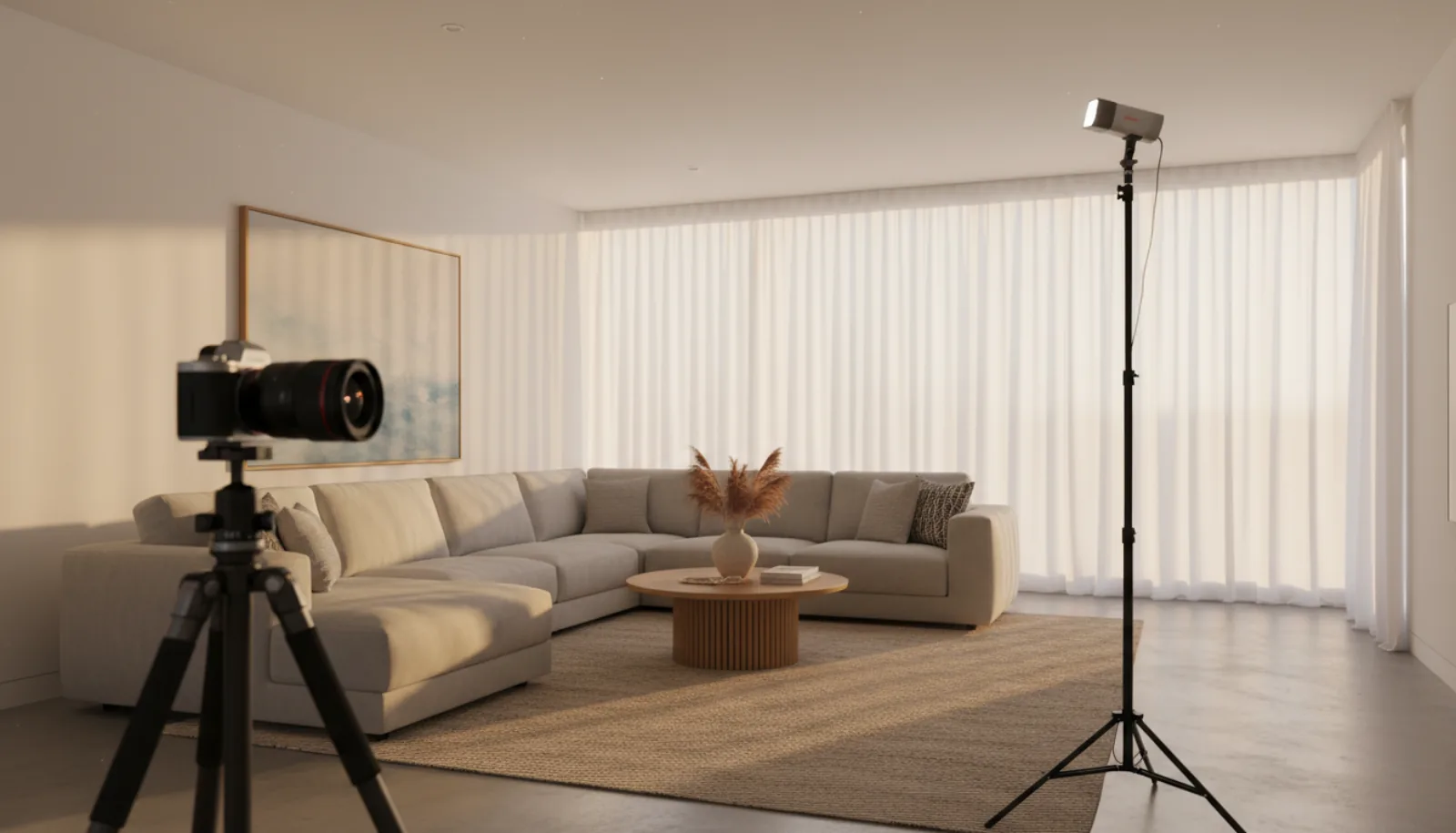
What an off-camera flash setup actually looks like deployed in a working interior — light stand bouncing into the ceiling, just outside the frame:
For a step-by-step on the bounce-flash technique that most working real estate photographers use — settings, modifier choices, and how to balance the flash against window light — Taylor Brown’s tutorial is the cleanest walkthrough out there:
Drone for aerial real estate photography
A drone has shifted from “nice to have” to standard kit for any property over $500k or with significant outdoor space. The DJI lineup dominates 2026 — there isn’t a serious competitor at the consumer or prosumer level.
Three picks by use case:
- DJI Mini 4 Pro ($760 with smart controller) — sub-249g, exempt from registration in most jurisdictions. 1/1.3” sensor, 4K/100fps video, vertical shooting mode. The right pick for 90% of agents.
- DJI Air 3S ($1,099) — dual-camera (1” + medium tele), better low-light. The mid-tier pick for full-time real estate photographers.
- DJI Mavic 3 Pro ($2,199) — Hasselblad 4/3” main camera, two tele lenses. The pick if you’re shooting luxury or commercial properties and need genuine stills-quality output.
Required accessories regardless of model: at least three batteries ($100 each), ND filter set ($60), a hard case ($100), and an FAA Part 107 license ($175 exam fee + study time) if you’re flying commercially in the US. Total drone setup: $1,200 entry, $2,800 mid, $4,500 pro.
For the full breakdown on legal requirements, shot lists, and editing aerial photos, see aerial photography for real estate and our drone video for real estate guide.
A note on regulations: as of 2025 the FAA Remote ID rule requires all drones over 250g to broadcast identification. The Mini 4 Pro at 249g is intentionally under the threshold — that’s why it remains the most popular real estate drone.
360 camera for virtual tours
If you’re offering virtual tours alongside still photography (and you should be — it’s a $200-400 add-on per listing), a dedicated 360 camera is faster and cleaner than stitching panoramas from a DSLR.
The two real options:
- Ricoh Theta Z1 ($1,050) — 1” dual sensors, RAW DNG output, the highest image quality in a single-shot 360 camera. The pro pick.
- Insta360 X3 ($450) — 1/2” sensors, much cheaper, easier app workflow. Good enough for residential tours, struggles in low light.
- Insta360 X4 ($500) — successor to the X3, 8K stills, better stitching. The right pick for new buyers in 2026.
A 360 camera shoots equirectangular panoramas in one click — no rotation, no stitching, no Photoshop work. Pair it with a monopod or invisible-stick (Insta360’s $30 selfie stick gets edited out automatically) and you can shoot a full 12-room tour in under 20 minutes.
For software to host and present the tours, see our breakdown of the best 360 virtual tour software and cameras for 360-degree virtual tours. BrightShot’s virtual tours feature accepts equirectangular panoramas directly from any of these cameras.
One note: don’t try to shoot 360 tours with a DSLR + nodal slider rig unless you genuinely enjoy the stitching workflow. It takes 4x as long and the output isn’t meaningfully better than a Theta Z1.
Real estate photography accessories
The small items that round out a working kit. Most agents skip half of these and regret it after the first shoot where something fails.
- X-Rite ColorChecker Passport ($100) — shoot one frame with this in the room, build a color profile in Lightroom, every other photo in the set color-matches automatically. Saves 20+ minutes of post per shoot.
- Tethering cable + Tether Tools relay ($150) — shoot directly to a laptop. Lets you check focus and framing on a 15” screen instead of a 3” LCD.
- CamRanger 2 ($350) — wireless tethering to an iPad. More expensive, more flexible than a cable.
- Spare batteries — minimum three per body. Mirrorless bodies eat through batteries 2-3x faster than DSLRs. Brand-name batteries only — third-party packs cause shutter errors at the worst times.
- High-speed SD/CFexpress cards — two 64 GB cards (Sony Tough G-series, $80; ProGrade Cobalt, $130). Don’t buy 256 GB+ single cards. If one card fails mid-shoot you lose the whole shoot.
- Card reader — ProGrade USB-C reader ($50). The plastic readers in the back of camera bodies are slow and unreliable.
- Microfiber cloths and rocket blower ($30 combined) — every interior shoot involves a smudge or a dust spot somewhere.
- Bubble level / hot-shoe level ($15) — even with a leveling base, double-check before you trip the shutter on a 9-bracket sequence.
- Floor protectors — disposable shoe covers ($20 for 100). Showing up to a luxury listing without these gets you uninvited.
- Camera bag — Peak Design Everyday Backpack 30L ($300) or Think Tank Airport Advantage ($300) for fly-in shoots.
The accessories total roughly $800-1,500 depending on whether you go cabled or wireless tethering and how much redundancy you build in. Don’t underspend on cards or batteries — these are the only items in the kit that fail mid-shoot.
Real estate photography gear by budget
Three full kit recommendations. Each one is a complete, working setup that handles residential interior shoots out of the box.
The $500 starter kit
For agents shooting their own listings or hobbyists testing the waters before going pro.
| Item | Price |
|---|---|
| Canon EOS RP body (used) | $400 |
| Canon RF 15-30mm f/4.5-6.3 IS STM | $550 |
| Manfrotto Befree Advanced tripod | $200 |
| Used speedlight + trigger | $80 |
| Two 64 GB SD cards | $50 |
| Two spare batteries | $50 |
Going over budget? Drop the speedlight and shoot ambient-only with AI lighting (see below) — total drops to $1,250 minus the second body, around $750. The honest version of this tier: $500 doesn’t quite get you a complete kit. Plan for $750-1,000 if you’re starting from zero. The deal-breaker piece is the lens — don’t compromise on the ultra-wide.
The $2,000 working pro kit
The standard real estate photographer’s kit. Handles 95% of residential listings without compromise.
| Item | Price |
|---|---|
| Sony a7 III body | $1,800 |
| Tamron 17-28mm f/2.8 Di III RXD | $800 |
| Manfrotto 055XPRO3 + 410 geared head | $650 |
| Two Godox V1 Pro speedlights | $660 |
| Godox Xpro II trigger | $70 |
| Two Manfrotto Nano Plus stands | $180 |
| X-Rite ColorChecker Passport | $100 |
| Three batteries + two 64 GB cards | $200 |
| Peak Design Everyday Backpack 30L | $300 |
This kit costs around $4,800 actual price — closer to the realistic working pro spend. The “$2,000” tier in real estate photography is more accurately $3,500-5,000 if you need every piece. To genuinely hit $2,000, drop to one speedlight + AI lighting in post, use a used a7 II ($600) instead of the a7 III, and skip the dedicated bag. That gets you to about $2,200.
The $5,000+ luxury / commercial kit
For full-time real estate photographers shooting $1M+ listings, commercial interiors, or architectural work.
| Item | Price |
|---|---|
| Canon EOS R5 Mark II body | $4,300 |
| Canon RF 15-35mm f/2.8L IS USM | $2,300 |
| Canon TS-E 17mm f/4L tilt-shift | $2,150 |
| Gitzo GT2542 Mountaineer + Arca-Swiss D4 head | $2,000 |
| Two Godox AD200 Pro strobes | $700 |
| Two 24-inch softboxes | $160 |
| Two heavy-duty light stands | $300 |
| DJI Mavic 3 Pro + accessories | $2,800 |
| Ricoh Theta Z1 | $1,050 |
| ColorChecker + tethering kit | $250 |
| Batteries, cards, cases | $500 |
Total: roughly $16,500. This is what a full-time architectural and luxury real estate photographer carries. The $5,000 tier mentioned in shopping guides usually assumes you already own a body and lens — at that point, $5,000 buys the strobes, drone, 360 camera, and tilt-shift to round out an existing kit.
Skip the gear with AI: BrightShot’s editing shortcut
Here’s the honest version of the equipment for real estate photography conversation in 2026: half the lighting gear in this guide exists to solve problems that AI now solves in post. For the broader picture of what AI editing replaces (and where it doesn’t), see our complete guide to AI real estate photo editing.
What AI editing replaces:
- Two-flash setup for window pulls → AI exposure blending matches interior brightness to window detail in one click. You shoot a single bracket, the model handles the rest. See BrightShot’s lighting enhancement.
- HDR brackets and tone mapping → AI handles the dynamic range compression with no halos and no manual masking. One ambient frame in, one balanced frame out.
- Manually removing furniture or clutter → AI declutter tools remove personal items from rooms in seconds. See BrightShot’s photo declutter feature.
- Hiring a virtual stager → AI virtual staging adds furniture to empty rooms for $1 per image vs $25-75 per image at traditional services. See BrightShot’s virtual staging.
The practical implication for a new real estate photographer: instead of spending $1,200 on a two-strobe lighting kit, spend $200 on a single speedlight and $19/month on BrightShot. The output quality is comparable for residential listings, the shoot times are shorter (no light setup between rooms), and the upfront capital is dramatically lower.
The pros who still buy the strobes are the ones shooting commercial interiors, architectural digest-style luxury, or anything where the lighting itself is part of the artistic intent. For 95% of MLS listings — which are the bread-and-butter of real estate photography revenue — AI editing replaces most of the lighting kit entirely.
The minimum AI-augmented kit:
- Used full-frame body + ultra-wide ($1,200)
- Solid tripod ($300)
- One speedlight for fill ($120)
- BrightShot subscription ($19/mo)
Total: $1,640 in gear plus $19/month in software. That kit produces listing-ready images that are difficult to distinguish from a $5,000 strobe-and-tilt-shift setup at web export resolution.
FAQ
What is the basic equipment for real estate photography?
The minimum equipment for real estate photography is a full-frame camera body, an ultra-wide lens (16-35mm equivalent), a tripod, and one off-camera flash. You can shoot working real estate photos with this kit alone. Total cost: $1,200-1,500 for a used setup.
How much does a complete real estate photography kit cost?
A working pro kit costs $2,000-5,000 depending on whether you buy used or new and how much lighting gear you carry. A starter kit can be assembled for $750-1,000 if you compromise on the body but not the lens. A luxury / commercial kit with tilt-shift, strobes, drone, and 360 camera runs $10,000-17,000.
Do I need a drone for real estate photography?
For listings under $500k, no — most buyers don’t need aerial context. For listings over $500k, properties with significant land, or any luxury or commercial work, yes. A DJI Mini 4 Pro at $760 is the entry point and stays under the 250g registration threshold in most jurisdictions.
Speedlights or strobes for real estate photography?
For residential interiors under 3,000 sqft, two Godox V1 Pro speedlights ($660 total) handle every shot. For larger homes, commercial interiors, or anywhere you need fast recycle times for HDR brackets, two Godox AD200 Pro strobes ($700 total) are the upgrade. Skip both and use AI lighting in post if you’re shooting MLS-grade listings.
What lens should I buy first for real estate photography?
An ultra-wide zoom in the 16-35mm full-frame equivalent range. Specific picks: Canon RF 15-30mm f/4.5-6.3 IS STM ($550), Tamron 17-28mm f/2.8 ($800) for Sony, or Nikon Z 14-30mm f/4 ($1,300). The lens matters more than the body — never buy a kit lens.
Can I do real estate photography without expensive lighting equipment?
Yes. Modern AI tools like BrightShot’s lighting enhancement handle exposure blending, shadow recovery, and window pulls in post. A single ambient frame becomes a balanced listing-ready image without the strobe setup. This is the single biggest cost reduction in 2026 for new real estate photographers.
What 360 camera should I buy for virtual tours?
The Insta360 X4 ($500) is the right pick for new buyers — 8K stills, easy app workflow, fast learning curve. Upgrade to the Ricoh Theta Z1 ($1,050) if you need RAW DNG output and 1” sensors for low-light interiors. See our cameras for 360-degree virtual tours guide for the full breakdown.